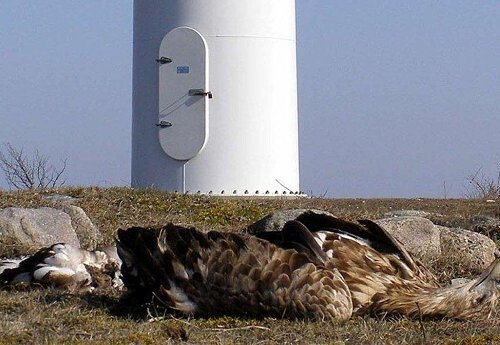
wind power push could wipe out nearly half of golden eagle population by 2050
The expansion of wind power is a key part of President Joe Biden’s climate agenda that seeks to replace fossil fuels with green energy sources like wind turbines in order to achieve net-zero carbon emissions economy-wide by 2050. The climate bill, which Biden passed into law on Tuesday, will entice developers to invest in wind projects through tax breaks and subsidies.
Deconstructing the Narrative: Finland’s Wind "Crisis"
The recent viral coverage regarding Finland’s wind power output utilizes a specific blend of localized failure and emotive rhetoric to construct a systemic indictment of renewable energy. While the core data point—frozen blades reducing capacity—is factual, the surrounding narrative relies on cognitive shortcuts rather than engineering analysis.
Here is a clinical decomposition of the logic, mechanics, and psychology at play.
I. The Narrative Engineering
The article employs the "Tyler Durden" persona—a collective pseudonym used to signal anti-establishment truth. This branding relies on specific psychological triggers to bypass analytical filters:
Loaded Language: Terms like "Green Dream," "Russian frosts," and profanity ("Fcked") are not descriptors; they are emotional anchors designed to induce an amygdala-based fear response.
False Dichotomy: The piece frames energy infrastructure as a binary choice: "unreliable" wind versus "stable" fossil/nuclear. This ignores the reality of modern hybrid grids where diverse sources (hydro, nuclear, wind) cover each other's deficits.
Anecdotal Validation: By citing individual social media complaints about heating bills, the text validates the reader's anxiety, creating a "bandwagon effect" that masks the lack of systemic data.
II. Logical Fallacies
The argument collapses when subjected to standard logical stress tests:
Hasty Generalization: It extrapolates a single weather event (severe icing reducing output to ~5%) to declare the entire national energy market a failure. This ignores Finland’s annual baseline, where renewables successfully provide the majority of power at low cost.
Cherry-Picking: The focus is exclusively on the trough of performance. It omits the proactive curtailment by grid operators and the role of the Olkiluoto 3 nuclear plant in successfully stabilizing the baseload during this exact period.
Causal Oversimplification: High prices are attributed solely to frozen turbines. In reality, the price spike was a function of three simultaneous variables: record demand from extreme cold, transmission bottlenecks, and low wind.
III. The Technical Reality
A "crisis" implies an unexpected breakdown. What happened in Finland was a predictable intersection of meteorology and economics.
Atmospheric Synchronization: Arctic high-pressure systems cause extreme cold and wind stagnation. Low wind output during a freeze is a known meteorological correlation, not an engineering surprise. The grid is designed with this correlation in mind.
The Specification Deficit: Wind turbines function in the Arctic when equipped with "Cold Climate Packages" (internal blade heating). The failure here was not of wind technology, but of specific operators opting out of de-icing upgrades to lower initial construction costs (CAPEX).
Marginal Cost Pricing: The Nord Pool market is designed to clear at the price of the most expensive megawatt needed to meet demand. When wind (cheap) drops out, the grid calls on gas/oil peaker plants (expensive). The price spike reflects the cost of that emergency backup, not the average cost of energy generation.
Summary
The narrative frames a functional price signal as a catastrophic system collapse. High prices during a freeze are the market doing exactly what it was designed to do: incentivize demand reduction and pay for expensive backup generation. Confusing a stress test with a failed state is a fundamental error in market analysis.