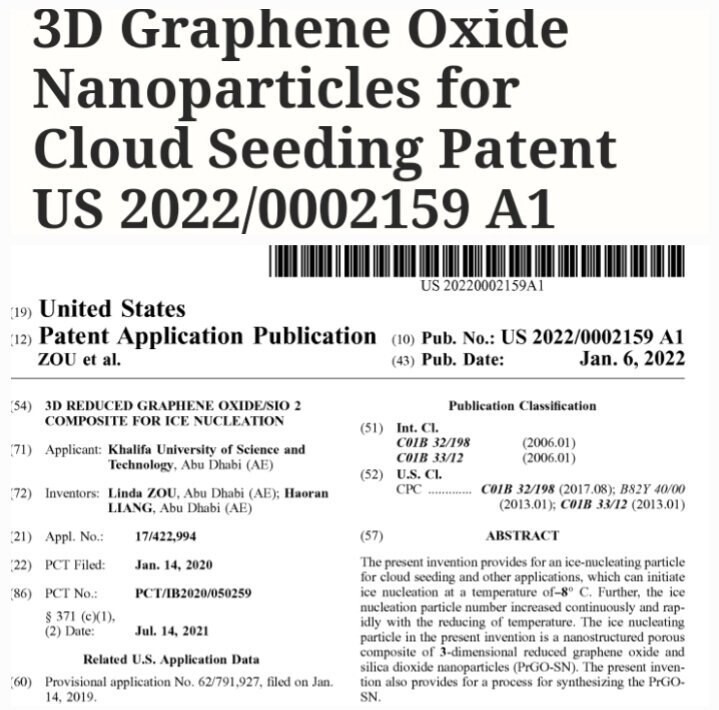
some pretty interesting analysis by ChatGPT Plus on this particular patent.
Analysis: US 2022/0002159 A1 — Graphene Oxide for Cloud Seeding
Initial verdict: This is a genuine patent application describing a technically plausible cloud-seeding material. It is supported by laboratory experiments and peer-reviewed research. It does not, by itself, establish that graphene-based nanoparticles are being dispersed into the atmosphere operationally.
An important finding: the patent was granted on April 16, 2024, as US 11,958,748 B2. It is no longer merely a pending application.
Google Patents+1
1. Patent identity
Property
Verified information
Official title
3D Reduced Graphene Oxide/SiO₂ Composite for Ice Nucleation
Publication
US 2022/0002159 A1
Granted patent
US 11,958,748 B2
Inventors
Linda Zou and Haoran Liang
Applicant
Khalifa University of Science and Technology, Abu Dhabi, UAE
Priority date
January 14, 2019
Published
January 6, 2022
Granted
April 16, 2024
Reported status
Active
Primary documents: Original patent application and Granted patent.
The technology is a three-dimensional porous composite of reduced graphene oxide (rGO) and silicon dioxide (SiO₂) nanoparticles, abbreviated PrGO-SN.
This distinction matters: the invention is not simply free-floating graphene oxide nanosheets. It uses graphene-derived sheets to construct a porous material incorporating silica nanoparticles.
ACS Publications
2. How the material works
Conceptual mechanism: grey network = reduced graphene oxide; gold particles = silica; blue structures = ice crystals. Schematic, not a microscopy image.
The proposed mechanism combines three effects:
- Water adsorption: Hydrophilic SiO₂ provides surfaces that attract water molecules.
- Ice nucleation: The porous graphene-derived structure offers surfaces and cavities where ice can begin forming.
- Ice growth: The interconnected structure may help dissipate heat released during freezing, while the pores accommodate additional crystal growth.
The authors report ice formation at approximately −8 °C with 5–8% supersaturation under their experimental conditions.
ACS Publications+1
The central idea is heterogeneous ice nucleation: reduce the energy barrier that prevents supercooled water from freezing.
Important limitation: Ice forming on a stationary laboratory sample does not establish that dispersing that material through a real cloud will produce additional rainfall.
3. What was actually demonstrated?
The patent reports several measured properties:
Measurement
Reported result
Ice nucleation onset
−8 °C
Ice growth
Rapid under controlled conditions
Specific surface area
178.84 m²/g
Water contact angle
36.2°
Pore dimensions
Approximately 10–100 nm
Testing method
Environmental scanning electron microscopy (E-SEM)
The researchers produced the composite, characterized its structure and observed ice formation under controlled laboratory conditions. Their related paper, Enhanced Ice Nucleation and Growth by Porous Composite of RGO and Hydrophilic Silica Nanoparticles, appeared in the Journal of Physical Chemistry C in January 2020.
ACS Publications+1
Strength of the evidence
Claim
Assessment
The material can be synthesized
Demonstrated
It promotes ice formation in laboratory conditions
Demonstrated by the inventors
It works in a larger cloud chamber
Preliminary supporting observations
It increases rainfall in natural clouds
Not established
It is environmentally safe when dispersed
Not established
It is currently being deployed
Not established
One technical caveat: the patent suggests that silver iodide needs temperatures around −25 °C for good ice nucleation. That is an oversimplification. A 2025 atmospheric study documented AgI-containing particles forming ice in natural clouds at −5 to −8 °C, although only about 0.1–1% of the released particles were estimated to nucleate ice. So the claimed performance advantage cannot be accepted from the temperature comparison alone.
4. The more revealing evidence: the UAE government research report
I located the actual final report from the UAE Research Program for Rain Enhancement Science, covering Linda Zou's research project from January 2016 to July 2019.
Original UAE government-funded research report (PDF)
This adds important context.
Looking to the skies: The growing interest in cloud seeding technology in the Gulf - Middle East Institute
The original report includes electron-microscopy observations of ice forming on the graphene/silica composite.
The report describes testing at a larger cloud chamber operated by the Karlsruhe Institute of Technology (KIT), Germany. It says the preliminary observations were promising, but the KIT numerical results were not provided in the report because of limited time and personnel. Further funded testing was proposed.
Even more important, the report describes scaling up a different material — sodium chloride particles coated with titanium dioxide (NaCl/TiO₂) — for cloud-seeding field trials.
It does not establish operational atmospheric release of the patented PrGO-SN material.
assets.ncm.gov.ae
This is a critical distinction between research-stage and deployment-stage evidence.
5. Environmental and human-health risks
This is where scrutiny is warranted.
Graphene-based materials are not automatically harmless, and their toxicity depends on particle size, surface chemistry, oxidation state, concentration, exposure route and persistence.
A 2024 review of respiratory toxicology identifies possible effects including inflammation, impaired particle clearance and pulmonary fibrosis under some experimental exposure conditions.
PubMed Central (PMC)
However, a small controlled human study published in Nature Nanotechnology in 2024 found no significant acute cardiorespiratory effects when 14 healthy volunteers inhaled specifically prepared graphene oxide nanosheets at 200 µg/m³ for two hours. That finding does not establish long-term safety or apply automatically to the patented graphene/silica composite.
PubMed Central (PMC)
For environmental deployment, I would require evidence concerning:
- The aerodynamic size distribution of the dispersed composite.
- Inhalation exposure and toxicity of the actual PrGO-SN formulation.
- Degradation, aggregation and persistence in soil and water.
- Environmental concentrations after repeated seeding operations.
- Independent ecological and atmospheric assessments.
The World Meteorological Organization explicitly recommends environmental and health evaluation when introducing new cloud-seeding agents. It also reports no significant demonstrated environmental or human-health effects from conventionally used silver iodide at previously studied operational exposures.
World Meteorological Organization
Risk conclusion: There is a legitimate unresolved environmental-safety question. Neither claims of safety nor claims of widespread harm are adequately established for this particular material.
6. Is this technology progressing toward actual use?
Yes, the underlying research direction is continuing.
A significant newer development is that Linda Zou was selected again in the UAE's sixth research funding cycle in 2025.
Her newer project is titled AI-assisted Development and Optimization of Glaciogenic Cloud Seeding Materials.
It involves designing new nanocomposites, using AI to optimize their properties, conducting controlled cloud-chamber experiments, and investigating routes toward commercialization. The program specifically discusses installing a Portable Ice Nucleation Experiment (PINE) cloud chamber at the UAE National Center of Meteorology.
uaerep.ae+1
That demonstrates continued institutional investment in ice-nucleating nanomaterials. It does not establish that the specific patented PrGO-SN formulation is being deployed.
In November 2026, the UAE also announced a seventh research cycle prioritizing, among other areas, optimized seeding materials and progression toward operational readiness.
uaerep.ae
7. Does the patent support broader geoengineering claims?
The title you supplied resembles a Zero Geoengineering article that reproduces the patent and subsequently links graphene research to wireless nanosensors, vaccines and the Internet of Bodies.
Those are separate technologies and claims.
Nothing in this patent establishes a connection to autonomous nanodevices, wireless communication, biological monitoring or covert mass aerosol deployment.
What it does establish is that researchers have deliberately developed graphene-derived materials as candidates for atmospheric cloud seeding.
That is a real, documented form of weather-modification research, not speculation.
Overall assessment
High confidence
High confidence
| Practical rainfall enhancement |
|
Unknown
| Operational atmospheric deployment of PrGO-SN |
|
Unverified
| Long-term environmental safety |
|
Unknown
My conclusion: This patent is more scientifically substantive than its social-media presentation might suggest. It has a credible experimental basis, government funding, a peer-reviewed publication and subsequent granted patent protection.
But the meaningful unanswered question is not whether graphene nanomaterials could be used for cloud seeding. That has been established as a serious technological research objective.
The question is whether the specific formulation has progressed from laboratory testing into atmospheric release, at what scale, and under what environmental-safety assessment.
I found no publicly documented field deployment of PrGO-SN in the sources examined. That is a limitation of the available evidence, not proof that no deployment has occurred.
That distinction is essential when assessing claims built around this patent.
so explain it simply, I've often seen people post all kinds of patents as proofs of things, how is this not proof of chemtrails?
The key distinction is a patent proves that someone has described an invention, not that the invention is being used.
In this particular case, there is actually more evidence than just a patent:
- Patent: Researchers invented a graphene-based material intended for cloud seeding.
- Laboratory evidence: They produced the material and demonstrated that it can help ice crystals form under controlled conditions.
- Government funding: The UAE funded research into these materials for rain enhancement.
- Real-world deployment: We have not established that this particular material has actually been released into the atmosphere.
So the first three points are supported by evidence. The fourth remains unverified.
But isn't cloud seeding basically chemtrails?
This depends on what someone means by chemtrails.
If they mean that aircraft deliberately release substances into the atmosphere to influence weather: Yes, that happens. It's called cloud seeding. It's a documented technology, not a conspiracy theory.
If they mean that ordinary aircraft contrails are evidence of a widespread, secret chemical-spraying program: No. This patent doesn't establish that.
The existence of cloud-seeding technology doesn't tell us whether an observed trail is a contrail or an intentional release.
Why patents are frequently misleading as evidence
Imagine finding a patent for a machine that manipulates human dreams.
That patent might establish that someone proposed a machine and specified how they thought it could work. It wouldn't prove that the machine works, that anyone manufactured it, or that governments secretly operate it.
Patents are primarily legal instruments protecting inventions. Patent offices generally do not require proof of commercial deployment or independent scientific validation.
The important nuance
I wouldn't dismiss this graphene patent as merely an idea on paper.
There's real experimental research behind it, and a government has invested in developing related technologies.
That deserves scientific and environmental scrutiny.
But consider the difference between these two statements:
- "Scientists and governments are developing materials that could be dispersed into clouds to influence rainfall." Supported.
- "Therefore, the aircraft trails people regularly see are evidence of a secret spraying operation." Not supported by this patent.
The general rule: A patent can be evidence of technological intent, design and sometimes experimental development. To prove actual deployment, you need additional evidence: operational records, procurement, equipment, flight data, environmental measurements or independently verified observations.
That missing connection between capability and actual use is precisely where many patent-based conspiracy arguments fail.