
 'The Americans picked the wrong country to learn geography' - Iran crushes US ambitions
1 Like
God Bless the Peace Makers
1 Like
Larry Johnson & Col. Wilkerson: It’s Over: Iran Just Wiped Out Trump’s Blockade - War IMMINENT
At least 16 American installations are heavily damaged and virtually unusable - CNN
MSM finally reporting on heavy damage to US bases in Middle East, weeks after it occured…..
Ana Kasparian says the Trump administration begged private satellite companies to hide images of destroyed US bases
Former CIA Larry Johnson says if Iran strikes U.S vessel tomorrow it will be an act of self defense
A look at Iran's fast attack boats - something Trump's Project Freedom will have to contend with
The Iranian military just announced the closure of the Strait of Hormuz for all vessels
The Iranians continue to resist. The audacity and arrogance of the Synagogue of Satan to name their latest Trojan Horse “Project Freedom”.
The Iran-U.S. Ceasefire Is Dead - And Trump Killed It
Dimitri Lascaris reporting live on 4th May 2026.
On Sunday, May 3, Donald Trump announced that the U.S. military would launch "Project Freedom" today (May 4). According to Trump, the U.S. Navy would "guide" vessels through the Strait of Hormuz, and the U.S. military would react "forcefully" to any attempt by Iran's military to intervene. Inevitably, this announcement led to a sharp escalation of military hostilities in the Strait of Hormuz today. The UAE and South Korea claimed that Iran attacked their ships, Iran claimed that it had struck a U.S. naval vessel, and the UAE alleged that Iran had fired drones at an industrial facility in the UAE. Are we about to see a return to all-out war? - D.L.
Free real-time missile tracker and live radar for the Iran vs Israel conflict.
1 Like
US & Israel Will Lose, If We Restart Iran War | Alastair Crooke & Lt Col Daniel Davis
"Netanyahu has something he's never had before - complete control of the US Armed Forces."
Not mentioned in this interview, is that the Iran-US/Israel war is a Rothschild war.

News Report: US Drone SHOT DOWN over Yemen w/Scott Ritter
The video below discusses the war being a bankster war / Rothschild war and it is that. What is lacking in the discussion is the solution (the only solution really) which is to learn, reinstate and apply The Laws of God. Because in Truth and reality that is really and the only way is 'how it ends'.

How the Iran War Ends — and Who Decides
 Timestamps:
0:00 – Intro
1:07 – Who ultimately controls when the Iran war ends
1:37 – Alex Krainer frames the conflict's true nature
9:59 – The financial powers driving the Iran operation
11:16 – Simon Dixon on the monetary reset connection
22:24 – Which faction benefits most from prolonged conflict
29:33 – Why the media narrative misses the real story
35:26 – The Iran timeline nobody is discussing in 2026
55:56 – What escalation means for Bitcoin and hard assets
1:07:10 – How this conflict ends — and who decides
1:26:48 – Final takes from Krainer and Dixon.
At the head of the death cult (Synagogue of Satan) is Satan and working with him on the worldly level below him is the pretending-to-be-a-king, the vampire  Charles, acting as the gatekeeper to keep The only real Law (which is of God) from being reinstated and applied; followed by the real "bank"-robbers of wealth, the Rothschild controllers of the money; thus, The Law and The Wealth being manipulated by Satanists. The current war that has taken the spotlight is the US-Israel versus Iran war. No doubt Rothschild plays a central role in keeping this war against Iran stoked. Why? The Iranian leadership (which includes the religious sect of Khomeini) seeks to apply The Law of NO USURY across the board in Iran. This is how it works: Islamic banks use equity participation systems. It means if a bank lends money to a business, the business will pay back the loan without interest and instead give the bank a share in its profits. [see article below].
Islamic banking in ascendancy: The case of Iran
The 34th Islamic Banking Conference started in Tehran on Tuesday with the participation of bank managers. The event is held every year on the day Iran adopted the law on usury-free banking operations.
Over the years, the conference has become a venue to develop banking knowledge and science, and exchange opinions between domestic and foreign experts with the aim of creating synergy in a worthy manner.
It has built up to one of the biggest scientific events in human sciences in general and Islamic banking in particular, where the latest studies and researches in global finance are presented and examined in the form of lectures, articles, specialized roundtables or educational workshops.
The need to establish an Islamic economic system arose in the wake of the Islamic Revolution in Iran in 1979 with the aim of eradicating usury and laying the foundation for a monotheistic economy based on equity (qist) and justice (‘adl).
Initial measures to Islamize the banking system were taken in 1980 when efforts were made to introduce interest-free financial services and loans which led to the emergence of Qarz al-Hasna funds. The first bill on usury-free banking was submitted to parliament in 1982 and the law came into effect in September 1983.
Under the new law, current account deposits, also called Qarz al-Hasana deposits, are treated as a loan from a customer to the Islamic bank; the bank should guarantee full payment of the principal amount on demand. Demand deposits are considered as Amanah which the bank is expected to hold in trust.
These deposits are deployed in financing, trading or investment activities by using the Shariah compliant modes of finance which bans sectors harmful to society such as alcohol, tobacco and gambling. The profit so earned by the bank is passed on to the depositors according to the pre-agreed ratio per which the lender deduces its fee from the profit.
Shariah also prohibits taking interest on loans. Islamic banks use equity participation systems. It means if a bank lends money to a business, the business will pay back the loan without interest and instead give the bank a share in its profits. If the business defaults or doesn't earn a profit, then the bank also doesn't benefit.
In general, Islamic banking institutions tend to be more risk-averse in their investment practices. As a result, they typically avoid business that could be associated with economic bubbles.
In 2020, London-based global financial analysis magazine The Banker included Iran’s Mellat Bank in the list of the world's top banks compliant with Islamic Sharia. The internationally renowned publication cited a 55.38% growth in the bank’s Sharia-compliant assets making it the second largest Islamic lender in the world.
According to The Banker, Iran and Saudi Arabia are the pioneer countries in Islamic banking with total assets of $400 billion, of which $82.3 billion belong to Bank Mellat.
Over the last half century, the usury-free banking has attracted the attention of many economies but the approach is new and classical interest-based banking is still dominant.
Total Sharia-compliant assets worldwide excluding Iran grew by 12.8% to $1.6 trillion in 2022, with 57% held by standalone Islamic finance institutions, according to data from The Banker Database. The growth registered was significantly higher than for the banking sector as a whole, which saw a 1.7% contraction in assets in dollar terms for 2022.
According to the Islamic Finance Development Report 2023, the Islamic finance industry is projected to grow to $6.67 trillion by 2027.
The theories and philosophy of capitalism have proved unsuccessful in offering solutions to the global economic woes. Many economists believe national and international economic distress is principally the consequence of debt-laden and interest-based financial structures of global banking and economic system.
The splendid growth of Islamic banking and finance and its progress in various regions of the world reflects its ability to deliver financial propositions that are not only Shariah-compliant but also pragmatic to cater to contemporary economic and financial needs.
Source: https://www.presstv.ir/Detail/2024/09/10/733019/Islamic-banking-in-ascendancy--The-case-of-Iran---

 The moment a U.S. MQ-9 reaper drone was shot down by Iranian air defenses near the strait of Hormuz last night
The Islamic Revolutionary Guard Corps declared on March 11 that US and Israeli “economic centres and banks” across the region were now legitimate military targets, according to Al Jazeera. The IRGC-affiliated Tasnim News Agency subsequently published a detailed list of American technology companies with regional offices designated as potential targets, Capacity Global reported.
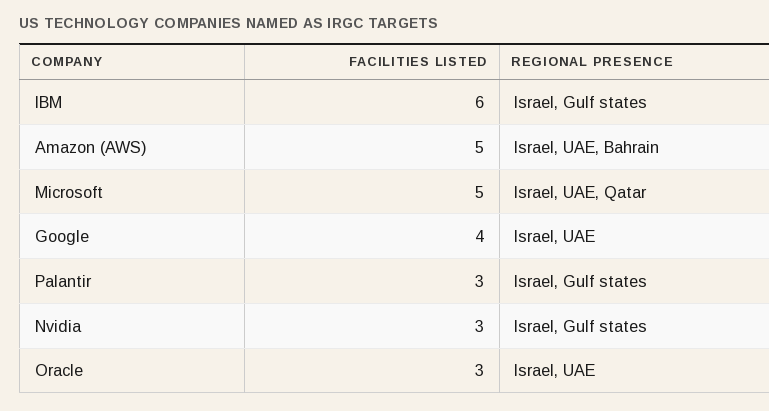
The named companies included Google, Microsoft, Amazon, Nvidia, IBM, Oracle, and Palantir. The IRGC list specified five Amazon facilities, five Microsoft locations, six IBM offices, three Palantir sites, four Google facilities, three Nvidia locations, and three Oracle buildings across Israel and Gulf countries, according to the Tasnim publication. The IRGC warned residents “not to be within a one-kilometre radius of banks” belonging to American or Israeli entities.
Iran’s Araghchi Demands Gulf Nations Expel American Forces
Iran FM Araghchi demands Saudi Arabia and Gulf states expel US military, threatens 7 American tech companies. 5 nations already bypassing Washington for Hormuz deals.
RIYADH — Iran’s Foreign Minister Abbas Araghchi on March 14 called on Saudi Arabia and other Gulf states to “expel foreign aggressors” from their territory, framing the American military presence across the region as the root cause of Iranian strikes on Gulf nations and threatening to target US corporate facilities if Washington escalates further. The demand, backed by Iran’s parliament speaker and the Islamic Revolutionary Guard Corps, represents Tehran’s most explicit attempt yet to fracture the US-Gulf security architecture that has anchored the region’s defense posture for more than three decades.
Araghchi’s ultimatum landed as the war entered its sixteenth day, with Iranian drones and missiles continuing to strike Saudi Arabia, the UAE, Qatar, Bahrain, Kuwait, and Oman. At least 1,444 people have been killed in Iran and 19 in Gulf states since the US-Israeli strikes began on February 28, according to figures compiled by NPR and Al Jazeera. The Iranian foreign minister dismissed the American security umbrella as “full of holes, inviting rather than deterring trouble,” while Parliament Speaker Mohammad Bagher Ghalibaf declared that “American bases in our region do not protect anyone — they are a threat.”
What Did Araghchi Demand From Gulf States?
Iran’s Foreign Minister Abbas Araghchi issued a coordinated diplomatic ultimatum to Saudi Arabia and other Gulf Cooperation Council members on March 14, demanding they remove American military forces from their territory. Araghchi called on “brotherly neighbours to expel foreign aggressors, whose only concern is Israel,” according to Al Jazeera’s live reporting and Pakistan Today, in the most direct demand of its kind since the war began on February 28.
The ultimatum carried three distinct components. First, Araghchi accused the American military presence of making Gulf states targets rather than protecting them. “The touted US security umbrella has proven to be full of holes,” he said, adding that Washington is “now begging others, even China, to help it make Hormuz safe.” Second, he warned that Iran would attack “facilities of American companies in the Middle East” if Iranian energy infrastructure faces further strikes, a direct reference to the US bombing of military installations on Kharg Island earlier that day. Third, he pledged that Iranian forces would act “with caution so that densely populated areas are not targeted,” an implicit acknowledgment that civilian casualties in Gulf states are eroding Tehran’s diplomatic position.
Parliament Speaker Mohammad Bagher Ghalibaf reinforced the message within hours. “American bases in our region do not protect anyone — they are a threat,” Ghalibaf said, arguing that the United States “sacrifices everyone for Israel.” The coordinated nature of the statements — foreign minister, parliament speaker, and IRGC commanders all delivering the same message within a 24-hour window — suggested a deliberate strategic communication campaign rather than spontaneous rhetoric.
How Is the IRGC Expanding Its Target List Beyond Military Sites?
The Islamic Revolutionary Guard Corps declared on March 11 that US and Israeli “economic centres and banks” across the region were now legitimate military targets, according to Al Jazeera. The IRGC-affiliated Tasnim News Agency subsequently published a detailed list of American technology companies with regional offices designated as potential targets, Capacity Global reported.
The named companies included Google, Microsoft, Amazon, Nvidia, IBM, Oracle, and Palantir. The IRGC list specified five Amazon facilities, five Microsoft locations, six IBM offices, three Palantir sites, four Google facilities, three Nvidia locations, and three Oracle buildings across Israel and Gulf countries, according to the Tasnim publication. The IRGC warned residents “not to be within a one-kilometre radius of banks” belonging to American or Israeli entities.
The escalation from military to corporate targets marked what the IRGC described as a shift from “conventional military engagement to infrastructure war.” The designation followed weeks of Iranian strikes on US military installations across the Gulf, including an attack that damaged five KC-135 tanker aircraft at Prince Sultan Air Base on March 14. Iran’s calculus appeared straightforward: if Gulf states would not expel American forces voluntarily, raising the cost of hosting American commercial interests might accelerate the decision.
The American Military Footprint in Saudi Arabia
The United States maintains approximately 2,300 troops in Saudi Arabia as of 2024, according to White House figures, concentrated primarily at two installations that have become focal points of the Iranian campaign. Prince Sultan Air Base, located roughly 100 kilometres southeast of Riyadh near Al Kharj, serves as the primary US military hub in the Kingdom. Satellite imagery from June 2025 showed 53 F-16 fighters, 22 KC-135 tankers, and several E-3 AWACS early warning aircraft stationed at the facility, according to analysis of commercial satellite data.
Eskan Village, a US military compound 20 kilometres southeast of Riyadh, houses the United States Military Training Mission in Saudi Arabia, the Office of the Program Manager for the Saudi Arabian National Guard Modernization Program, and several other training and advisory missions. The facility supports the backbone of the US-Saudi defense relationship — the training programs, maintenance contracts, and advisory missions that keep Saudi Arabia’s American-supplied arsenal operational.
Beyond Saudi Arabia, the US military footprint across the Gulf includes Al Udeid Air Base in Qatar, which serves as the forward headquarters of US Central Command with approximately 10,000 troops. Bahrain hosts the US Fifth Fleet, and Kuwait, the UAE, and Oman all maintain varying degrees of American military presence. Iran’s strikes have hit or threatened every one of these installations since February 28.
The Saudi Defence Ministry confirmed on March 2 that five hostile drones were intercepted near Prince Sultan Air Base. On March 14, an Iranian strike damaged five US tanker aircraft at the same base, representing the most significant material damage to American military assets on Saudi soil since the war began. Three ballistic missiles were also intercepted near the base on March 6, according to the Qatar News Agency.
Why Can Saudi Arabia Neither Accept Nor Reject Iran’s Demand?
Crown Prince Mohammed bin Salman faces what several regional analysts have described as the most consequential strategic decision of his tenure. Accepting Iran’s demand to expel US forces would dismantle the security architecture that has underpinned Saudi Arabia’s defense posture since the Gulf War in 1991, eliminate the deterrent value of American military presence, and potentially trigger a collapse of the $3.5 billion arms pipeline approved by the US State Department in May 2025 for 1,000 AIM-120C-8 missiles. It would also signal to Washington that Saudi Arabia had chosen Tehran over the alliance — a message with unpredictable consequences for the Kingdom’s broader strategic position.
Rejecting the demand, however, means accepting continued Iranian strikes on Saudi territory, with civilian casualties already mounting. Two people were killed in Al Kharj on March 9 when Iranian munitions reached residential areas, according to Al Arabiya. Saudi air defenses have intercepted hundreds of drones and missiles since the war began — 31 in a single day on March 13, including projectiles targeting Riyadh’s Diplomatic Quarter — but the rate of incoming fire is testing the limits of even the Kingdom’s extensive air defense network.
The Kingdom has so far navigated the crisis by refusing to enter the war as a combatant while maintaining its alliance with Washington. Mohammed bin Salman has condemned Iran’s strikes as “a violation of international law and a deliberate attempt to destabilise the region,” according to Saudi state media, but has stopped short of authorising offensive military operations against Iran. Pakistan’s Prime Minister Shehbaz Sharif flew to Jeddah on March 12 for an emergency meeting with MBS, pledging Pakistan’s full solidarity, while Field Marshal Syed Asim Munir — Pakistan’s army chief — attended alongside Deputy Prime Minister Ishaq Dar. Araghchi’s demand to expel American forces is calculated to exploit what analysts describe as a fundamental rewriting of the Saudi social contract under wartime conditions. Meanwhile, Iran’s ambassador to Saudi Arabia denied responsibility for strikes on Saudi oil infrastructure, insisting Tehran targets only American and Israeli assets.
Nations Bypass Washington to Negotiate Directly With Tehran
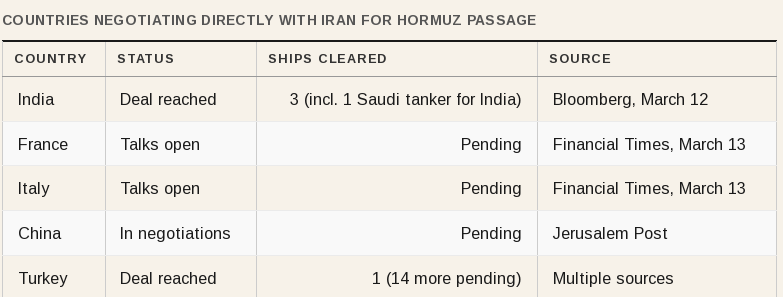
Perhaps the most damaging indicator of Araghchi’s strategy succeeding came not from the Gulf states but from US allies negotiating directly with Iran for Strait of Hormuz passage — bypassing Washington entirely. France and Italy opened talks with Iran on securing safe passage for their vessels, the Financial Times reported on March 13. India struck a deal with Tehran to transit more than 20 tankers through the strait, Bloomberg reported on March 12, with two Indian-flagged gas carriers and a Saudi oil tanker carrying one million barrels of crude for India successfully passing through.
China, displeased with Tehran’s closure of a waterway through which 45 percent of Chinese oil and gas imports transit, began its own parallel negotiations with Iran, according to the Jerusalem Post. Turkey secured passage for one vessel earlier in the week after Ankara negotiated directly with Tehran, with 14 more Turkish ships awaiting clearance.
The bilateral negotiations undermined Washington’s preferred approach — a multilateral naval escort operation. President Trump called on March 14 for China, France, Japan, South Korea, and Britain to send warships to help reopen the Strait of Hormuz. But several of those same nations were simultaneously cutting side deals with Tehran, suggesting they viewed Iranian cooperation as more reliable than American military coercion. Araghchi’s statement that Washington is “now begging others, even China, to help it make Hormuz safe” appeared to be a direct reference to this dynamic.
The War’s Two-Week Toll on Gulf States
NPR’s assessment of the war’s first two weeks, published March 14, documented the scale of destruction that lends urgency to Iran’s ultimatum. At least 1,444 people have been killed in Iran and over 10,000 injured. In Gulf states, at least 19 people have died, including 16 civilians and three military personnel. Lebanon, drawn into the conflict through Israeli strikes, has lost 773 people since March 2.
The economic toll extended far beyond energy markets. The US has spent approximately $16.5 billion in the first 12 days of the campaign, with early spending running at $3.7 billion per 100 hours. Brent crude peaked at $119.50 per barrel before the International Energy Agency authorised a record 400 million barrel emergency oil release, including 172 million barrels from the US Strategic Petroleum Reserve. Bahrain’s state oil company BAPCO declared force majeure on March 9 after Iranian strikes set its only refinery ablaze, joining QatarEnergy and Kuwait in suspending deliveries.
For Saudi Arabia specifically, the war has damaged critical infrastructure including the Shaybah oil field in the Empty Quarter and threatened the Ras Tanura terminal — Aramco’s largest export facility. The Kingdom has rerouted much of its oil flow from the Persian Gulf to its west coast via the East-West Pipeline, loading tankers in the Red Sea to bypass the Hormuz chokepoint. The US embassy in Riyadh was struck by two Iranian drones, causing what Saudi authorities described as “limited fire and minor material damages.”
Washington’s Response and Hormuz Strategy
The Trump administration responded to Iran’s escalating rhetoric with a combination of military action and diplomatic pressure. On March 14, US forces bombed military installations on Kharg Island, Iran’s critical oil export hub through which approximately 90 percent of Iranian crude exports flow, according to Al Jazeera. The Trump administration deliberately spared oil infrastructure on the island but warned that energy sites “could become targets” if Iran continued disrupting Strait of Hormuz shipping.
Trump declared he wanted the strait “OPEN, SAFE, AND FREE” and proposed a multinational naval force to enforce passage. He called on six nations — China, France, Japan, South Korea, Britain, and an unspecified sixth — to contribute warships. Pentagon officials vowed to “ramp up” the military campaign against Iran, while Defense Secretary Pete Hegseth claimed that Iran’s new supreme leader Mojtaba Khamenei was “wounded and likely disfigured” from earlier strikes, according to Al Jazeera’s March 14 reporting.
The US State Department separately offered a $10 million reward for information on Khamenei and other top Iranian officials. The State Department also ordered non-emergency US government employees and their family members to leave Saudi Arabia on March 8, upgrading a previous authorisation from March 3 to a mandatory departure order.
But the gap between Washington’s ambitions and its capacity to deliver was widening. Operation Maritime Shield, the US-led naval effort to reopen the strait, has not yet secured passage for commercial shipping. Hormuz transit has fallen to just 77 ships, according to maritime data firm reports cited by The Nation. Over 3,000 vessels remain stranded in the Persian Gulf. And the spectacle of France, India, and Turkey negotiating side deals with Tehran — while Washington asked those same nations to send warships — raised questions about whether the American-led security order in the Gulf was fracturing in real time. That fracture deepened further when Trump blocked ceasefire efforts while Araghchi declared Tehran had never asked for negotiations.
What Comes Next for the US-Gulf Alliance?
Araghchi’s ultimatum is unlikely to produce an immediate Saudi decision to expel US forces. The Kingdom remains dependent on American military hardware — from Patriot and THAAD missile defense systems to the F-15SA fighters that form the backbone of the Royal Saudi Air Force — and a rupture with Washington would jeopardise the maintenance contracts, spare parts supply chains, and training programs that keep those systems operational. The $3.5 billion AIM-120C-8 missile sale, approved by the State Department in May 2025, represents only the latest in a pipeline of weapons transfers that ties Saudi Arabia’s defense capabilities to the American industrial base.
But the demand may not need to succeed on its own terms to achieve Iran’s strategic objective. Each day that Gulf states absorb Iranian strikes while hosting the American forces that Tehran identifies as the cause of those strikes — and each bilateral deal that France, India, or Turkey cuts with Iran for Hormuz passage — erodes the perceived value of the US security umbrella. If Saudi Arabia’s leadership comes to believe that American bases attract more risk than they deter, the calculus shifts. Not through a dramatic expulsion, but through a quiet drawdown of the kind that has already reduced the US military footprint in the Kingdom from its Gulf War peak of 45,000 troops to today’s 2,300.
The IRGC’s targeting of American corporate facilities adds a commercial dimension to the pressure. Saudi Arabia has spent years courting Amazon, Google, Oracle, and other technology giants as part of its Vision 2030 diversification strategy. If those companies conclude that their Gulf offices are now military targets, the investment case for the region weakens — and with it, one of MBS’s signature initiatives. The IRGC made this threat explicit on March 16, ordering the evacuation of all American-linked industrial facilities and warning that strikes on technology and defence sites would follow.
For now, Riyadh’s strategy remains what it has been since February 28: absorb the strikes, intercept what it can, refuse to escalate, and wait for Washington and Tehran to find a way out of a war that Saudi Arabia did not start but cannot escape. Araghchi’s ultimatum is designed to make that waiting game more expensive with each passing day.
Frequently Asked Questions
What did Iran’s foreign minister demand from Gulf states?
Foreign Minister Abbas Araghchi called on Saudi Arabia and other Gulf Cooperation Council members to “expel foreign aggressors” — meaning US military forces — from their territory. He claimed the American security umbrella was “full of holes” and warned Iran would target US corporate facilities if its energy infrastructure faced further strikes. Parliament Speaker Ghalibaf reinforced the demand, calling US bases “a threat” rather than a source of protection.
How many US troops are stationed in Saudi Arabia?
The United States maintains approximately 2,300 troops in Saudi Arabia, primarily at Prince Sultan Air Base near Al Kharj and Eskan Village near Riyadh. The Gulf-wide US military footprint includes roughly 10,000 troops at Al Udeid Air Base in Qatar, the US Fifth Fleet in Bahrain, and additional forces in Kuwait, the UAE, and Oman. All of these installations have been struck or threatened by Iranian forces since the war began on February 28.
Which US companies has the IRGC designated as targets?
The IRGC published a list naming Google, Microsoft, Amazon, Nvidia, IBM, Oracle, and Palantir as potential targets. The list detailed specific facilities across Israel and Gulf countries, including five Amazon locations, five Microsoft sites, six IBM offices, four Google facilities, and multiple Palantir, Nvidia, and Oracle buildings. The IRGC warned civilians to maintain a one-kilometre distance from American and Israeli banking institutions.
Are countries negotiating directly with Iran for Hormuz passage?
Multiple US allies have opened direct negotiations with Tehran. India reached a deal allowing at least three vessels through, including a Saudi tanker carrying oil for India. France and Italy opened talks with Iran, according to the Financial Times. China and Turkey have also engaged in direct negotiations. These bilateral deals bypass the US-led Operation Maritime Shield, undermining Washington’s strategy for reopening the strait through military force.
What has been the war’s toll after two weeks?
As of March 14, at least 1,444 people have been killed in Iran with over 10,000 injured and 3.2 million temporarily displaced. In Gulf states, 19 people have died. Thirteen US service members have been killed. The US has spent approximately $16.5 billion in 12 days. Brent crude peaked at $119.50 per barrel, prompting the IEA to release a record 400 million barrels from emergency reserves. Over 17 commercial vessels have been attacked in the region.
Operation Cognitive Dissonance: TRUMP ENDS HORMUZ NAVAL BLOCKADE
President Trump announced on Friday that the U.S. naval blockade on the Strait of Hormuz “will now be lifted,” and that he is on the verge of a deal with Iran to move toward continuing talks. However, Tehran was quick to reject Trump’s claims that there would be no fee on traffic through the Strait, that Iranian assets wouldn’t be released, and that the U.S. would somehow get access to Iran’s stockpile of enriched uranium.