Americans Have Rights Because of God
Responding to audience calls for ICE crackdowns, Knight argues rights come from God, not the state. He warns that dehumanizing immigrants erodes liberty for everyone. - D.K.
Responding to audience calls for ICE crackdowns, Knight argues rights come from God, not the state. He warns that dehumanizing immigrants erodes liberty for everyone. - D.K.
At 2:15 in the video, Sen. John Thune made sure he showed his Freemasonic hand signal.
Matthew 23:1 Then spoke Jesus to the multitude, and to his disciples (the Apostles),
23:2 Saying, The lawyers and the politicians sit in Moses' [Law] seat:
23:3 All therefore whatsoever they bid you observe [of God's Law], [that] observe and do; but do not ye after their example: for they say, and do not (and make up their own laws against God's Orders - Deut. 4:2).
23:4 For they bind heavy burdens (the Talmud) and grievous to be borne, and lay [them] on men's shoulders; but they [themselves] will not lift one of their fingers to remove them. King of kings' Bible - Matthew
Proverbs 22:7 The rich ruleth over the poor, and the borrower [is] servant to the lender. King of kings' Bible - Proverbs
"Debt is one of the most dangerous things for any person or family in America. If you study the history of finance, any society that, adopts it's called usury, or interest rates at above a certain market or natural level, it's a matter of time before they fail. America, unfortunately, in the '80s and '90s, essentially legalized usury. And it is one of the critical parts of what I call the financial coup. And it's one of the reasons we are failing as a society.
"And that is because you have insiders who are paying anywhere from zero to a very small percent to borrow money, and outsiders who are paying on average 17 to 50%. And it's a matter of time if, if the insiders have total surveillance access to all of our data and can borrow money essentially for free, and we have no access to the data or the knowledge, and we're paying anywhere from 17 to 30%.
"You know, it's a matter of time. It's a matter of mathematical certainty that the outsiders are going to end up with nothing and being slaves. And this has been instituted very much through the credit card and financial systems."
Revelation 11:7 And when they shall have finished their Testimony (the 1260 "days" ended on 9/Dec./1917 - the day that Jerusalem was liberated from Gentile domination by Israel - British forces - Ezekiel 25:14), the beast (system - Satanic-Communism) that ascendeth out of the Bottomless Pit shall make war against them, and shall overcome them, and KILL them. King of kings' Bible - Revelation
Satan's Little Season (began in 1917?): The Balfour Declaration, issued on November 2, 1917, was a statement by the British government expressing support for the establishment of a "national home for the Jewish people" in Palestine. This declaration is considered a significant moment in the history of Zionism and has had lasting implications for the Israeli-Palestinian conflict.
Not expecting this from Trump et al:
The “Year of Release,” where all debts are forgiven/cancelled every seven years, and the “Year of Jubilee” every fifty years, where all property is redistributed back to its owner and the wealth shared out, so that there will be no poor amongst the people.
Deuteronomy 15:1 At the end of every seven years thou shalt make a release.
15:2 And this is the manner of the release: Every creditor that lendeth ought unto his neighbour shall release it; he shall not exact it of his neighbour, or of his brother; because it is called the Lord's release.
15:4 Save when (to the end that) there be no poor among you; … King of kings' Bible - Deuteronomy
Leviticus 25:10 And ye shall hallow the fiftieth year, and proclaim Liberty throughout all the land unto all the inhabitants thereof: it shall be a Jubilee unto you; and ye shall return every man unto his possession, and ye shall return every man unto his family. King of kings' Bible - Leviticus
The "Q" people in the past talked about a debt release. IF that were to come from THEM, it would come with a heavy burden to include the furtherance of slavery.
Matthew 23:4 For they bind heavy burdens (the Talmud) and grievous to be borne, and lay [them] on men's shoulders; but they [themselves] will not lift one of their fingers to remove them. King of kings' Bible - Matthew
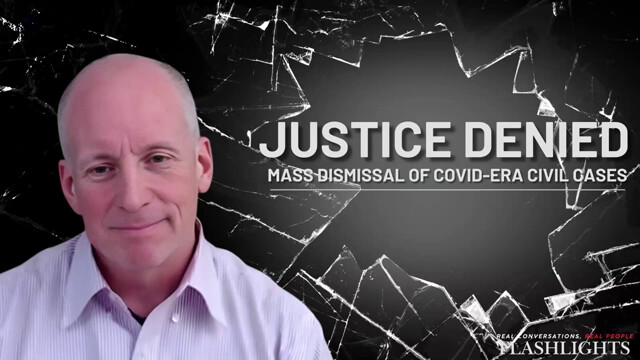
In 2020, the year society was locked down and basic constitutional rights of the entire US population were discarded, civil cases increased by more than 60%. In that year alone, there was an excess of lawsuits compared to prior years of over 180,000 cases. John Beaudoin says: “Did they hire 62% more people to handle those cases? No. Did everybody in the court system, all the judges and all the clerks, work 62 % more hours? Like 14 hours a day, every day for a year? No. There’s only one way to do this: Dismiss, dismiss, dismiss.”
Seth Holehouse is a popular podcaster that is known from his website Man in America. I've shared some of his videos and he brings attention to important topics that MSM refuses to broadcast. Kudos to him. Recently, he posted a transcription to one of his latest videos titled The Epstein Files Broke Something in Me. It is 'a personal, reflective monologue' (those are his words) in response to the recent release of Epstein-related documents. The title alone indicates he has been shaken by the contents and is learning how to deal with it. Understandably. However, I was met with disappointment when reading some portions of the transcript [https://x.com/Maninamerica/status/2021645595266478385].
For example:
Referring to an author, psychologist that Seth shows admiration for, Seth states: "His core finding is this: societies don't collapse simply because of bad policies or corrupt laws." - End of quote.
The truth is that that is the very reason why societies collapse. What evil (satanically inspired) fears most is The Law of God being reinstated and applied. Sadly, Seth is promoting the opposite with that seemingly innocuous statement.
There is truth expressed in his monologue too, but statements like the above are noticed and it is disheartening to hear it from someone who is in a position of influence.
At the end, he states (Seth is basically touting the ideas of the psychologist he admires), that "the real victory is awareness" .... he goes on to say, It's the thing evil fears most. Not law enforcement. Not investigations. Not even punishment. What it fears most is being seen. Being recognized for what it is.
The truth is THEY fear Law (God's) enforcement, beginning with investigations and ending with rightful punishment. How can Seth speak such nonsense?
When Jesus said "do not judge", he was not teaching to allow the evil to continue. Will exposing their deeds be enough to stop THEM? I understand where Seth Holehouse is coming from; because Jesus taught patience, tolerance, forebearance and forgiveness; however, Jesus was not a pacifist. He was a revolutionary and what Seth is promoting is not only not revolutionary, it lacks the necessary deterrence to fight and stop evil. I hope Seth will find the Truth.
Here’s a charge I hear surprisingly often. From John Loftus in God or Godless?:
Child sacrifice was commanded of the Israelites by Yahweh, the biblical God. In Exodus 22:29–30 we read:
You shall not delay to offer from the fulness [sic] of your harvest and from the outflow of your presses. The first-born of your sons you shall give to me. You shall do likewise with your oxen and with your sheep: seven days it shall be with its dam; on the eighth day you shall give it to me. (RSV)
The context of this passage concerns offerings and sacrifices, and it says God requires firstborn sons to be literally sacrificed to him. Later on we find Yahweh admitting he commanded this in Ezekiel 20:25–26, where he purportedly said:
Moreover I gave them statutes that were not good and ordinances by which they could not have life; and I defiled them through their very gifts in making them offer by fire all their first-born, that I might horrify them; I did it that they might know that I am the LORD [Yahweh]. (RSV)
I’ll take those two passages one at a time, and then I’ll quote a passage that should definitively put an end to the idea that God required child sacrifice.
First, Exodus 22:29–30. In order to understand what is meant by “give to me” in reference to firstborn sons, we need to look earlier in the book of Exodus where God gives the specifics of how this is to be done, for Exodus 22:29–30 only addresses when the command is to be carried out; it doesn’t contain the instructions on how to do it (and contrary to Loftus, these verses aren’t anywhere near a section devoted to sacrifices). For the instructions, we need to go back to Exodus 13:12–13:
[Y]ou shall devote to the Lord the first offspring of every womb, and the first offspring of every beast that you own; the males belong to the Lord. But every first offspring of a donkey you shall redeem with a lamb, but if you do not redeem it, then you shall break its neck; and every firstborn of man among your sons you shall redeem.
I don’t know how that could be clearer (and it’s repeated again in Exodus 34:20: “You shall redeem all the firstborn of your sons”). They are to sacrifice the animals, but redeem the sons. It helps to understand why God commanded this, which is explained in the verses immediately following, Exodus 13:14–15:
And it shall be when your son asks you in time to come, saying, “What is this?” then you shall say to him, “With a powerful hand the Lord brought us out of Egypt, from the house of slavery. It came about, when Pharaoh was stubborn about letting us go, that the Lord killed every firstborn in the land of Egypt, both the firstborn of man and the firstborn of beast. Therefore, I sacrifice to the Lord the males, the first offspring of every womb, but every firstborn of my sons I redeem.”
These verses tie the firstborn-son command to God’s rescue of the Israelites in the Exodus. God was merciful to the firstborn of the Israelites by not destroying them along with the firstborn of the Egyptians, and as a result, now they all belong to Him. Exodus 13:1–2, the introduction to this chapter, explains:
Then the Lord spoke to Moses, saying, “Sanctify to Me every firstborn, the first offspring of every womb among the sons of Israel, both of man and beast; it belongs to Me.”
And just as God redeemed His sons from the death of the firstborn, so the Israelites are to redeem their sons. Chapter 13 sets all of this up immediately after the Israelites begin the Exodus. Child sacrifice fits neither with the specifics of these instructions, nor with the practice’s overall purpose of serving as a continual visual reminder of God’s redemption of the firstborn in the Exodus. If the Israelites had killed their firstborn, they would have been identifying their sons with the Egyptian firstborn who were killed under God’s judgment. That would obviously go against God’s stated purpose for commanding this in the first place.
Now let’s look at the Ezekiel verses. They come at the end of a passage of judgment by God against Judah that recounts their rebellion even as far back as the 40 years in the wilderness. Here are excerpts to give verses 20:25–26 more context, in the more literal NASB:
I took them out of the land of Egypt and brought them into the wilderness. I gave them My statutes and informed them of My ordinances, by which, if a man observes them, he will live.... But the children rebelled against Me; they did not walk in My statutes, nor were they careful to observe My ordinances, by which, if a man observes them, he will live.... So I resolved to pour out My wrath on them, to accomplish My anger against them in the wilderness. But I withdrew My hand and acted for the sake of My name, that it should not be profaned in the sight of the nations in whose sight I had brought them out. Also I swore to them in that wilderness that I would scatter them among the nations and disperse them among the lands, because they had not observed My ordinances, but had rejected My statutes and had profaned My Sabbaths, and their eyes were on the idols of their fathers. I also gave them statutes that were not good and ordinances by which they could not live; and I pronounced them unclean because of their gifts, in that they caused all their firstborn to pass through the fire so that I might make them desolate, in order that they might know that I am the Lord....
Will you defile yourselves after the manner of your fathers and play the harlot after their detestable things? When you offer your gifts, when you cause your sons to pass through the fire, you are defiling yourselves with all your idols to this day.
The first thing to note here is that God says they defile themselves when they burn their children. God is against it and “pronounced them unclean” because of it. We also see that God first gave them statutes “by which, if a man observes them, he will live.” This is what God wanted for them—life. But they rejected those statutes, returning to idols; and attached to those idols were statutes of death, by which they defiled themselves. They would not have statutes of life? Then, God says, here are your idols’ statues of death. God gave them over to these statutes of death so He could judge them for their evil through their own actions, showing that He is Lord and judgment awaits those who reject His life-giving commands. Romans 1:18–29 gives some insight into this idea:
For the wrath of God is revealed from heaven against all ungodliness and unrighteousness of men who suppress the truth in unrighteousness.... Professing to be wise, they became fools, and exchanged the glory of the incorruptible God for an image in the form of corruptible man and of birds and four-footed animals and crawling creatures....
And just as they did not see fit to acknowledge God any longer, God gave them over to a depraved mind, to do those things which are not proper, being filled with all unrighteousness, wickedness, greed, evil; full of envy, murder, strife, deceit, malice.
The “giving over” of cultures to do evil is part of God’s judgment. Just as God did not command the people of Romans 1 to murder, so He did not command the Israelites to burn their children in the fire. But He gave both over to the evil they desired so that “they might know that He is the Lord” through His judgment of that evil. Since His judgment proves He is against that evil, ironically, the Ezekiel passage is merely more evidence of God’s hatred of child sacrifice.
Now we come to the nail in the coffin of the claim that “the biblical God required child sacrifices for His pleasure”—Deuteronomy 12:29–32:
When the Lord your God cuts off before you the nations which you are going in to dispossess, and you dispossess them and dwell in their land, beware that you are not ensnared to follow them, after they are destroyed before you, and that you do not inquire after their gods, saying, “How do these nations serve their gods, that I also may do likewise?” You shall not behave thus toward the Lord your God, for every abominable act which the Lord hates they have done for their gods; for they even burn their sons and daughters in the fire to their gods.
Whatever I command you [specifically, in this context, in how to properly worship God], you shall be careful to do; you shall not add to nor take away from it [i.e., by following the examples of the other nations’ worship practices].
This passage is the definitive response to those who claim God required the Israelites to engage in child sacrifice, because it closes a possible loophole: Some atheists argue that the only problem God had with the Israelites sacrificing their children was that they burned them to other gods; but here, the command specifically says they “shall not behave thus toward the Lord.” They’re not to serve their God the way the nations serve their gods, particularly not in this way. Why? Because, the text says, burning sons and daughters in the fire is an “abominable act which the Lord hates”—not merely when it’s done for other gods, but when it’s done toward the Lord. When the text says, “Every abominable act which the Lord hates they have done for their gods,” it’s the acts themselves that are specifically being condemned.
In other words, the Israelites are not to learn how to worship Yahweh by watching how other nations worship their gods because the nations worship their gods with abominable acts the Lord hates. Further, by saying, “For they even burn their sons and daughters,” the act of ritual child sacrifice is cited here as being the ultimate example of an abominable act.
Loftus claims Ezekiel, in the sixth-century passage cited above (nearly a thousand years after Moses), tried to rationalize the Torah’s command to sacrifice the firstborn because “in his time [he] had come to realize that child sacrifice was repugnant.” But we don’t need to wait for the sixth century. We don’t even need to go beyond Moses and the Torah. Before the Israelites even entered the Promised Land, they were vehemently warned against sacrificing their sons and daughters to Yahweh.
Source: God Didn’t Command Child Sacrifice
In the Old Testament, the practice of child sacrifice is often associated with the worship of pagan deities such as Molech and Baal. God repeatedly condemns these abhorrent practices and commands the Israelites to not engage in them.
The idea of human sacrifice is a deeply troubling and morally reprehensible practice that has been carried out by various cultures throughout history. Some critics of the Bible have pointed to certain passages as evidence that God commanded or condoned human sacrifices.
However, a closer examination of these passages reveals a more nuanced and complex understanding of the relationship between God and human sacrifice in the Bible.
One of the most well-known instances of a potential human sacrifice in the Bible is the story of Abraham and Isaac in Genesis 22. In this passage, God commands Abraham to sacrifice his son Isaac as a test of his faith. Abraham obediently prepares to carry out the sacrifice, but at the last moment, God provides a ram as a substitute, sparing Isaac's life.
At first glance, this story may seem to suggest that God desired human sacrifice. However, a deeper examination reveals that the true purpose of the narrative is to test Abraham's faith and obedience, rather than to condone or command human sacrifice. The story ultimately demonstrates Abraham's unwavering devotion to God and his willingness to trust in God's providence, even in the face of a seemingly impossible command.
Another passage that is sometimes cited in discussions of human sacrifice is the story of Jephthah in Judges 11. Jephthah vows to offer a sacrifice to God if he is granted victory in battle, and tragically, his only daughter is the first to greet him upon his return. Despite Jephthah's anguish and remorse, he ultimately fulfills his vow and sacrifices his daughter.
This story is a tragic example of the consequences of making rash vows and the damaging effects of literal interpretations of religious obligations. It does not depict God commanding human sacrifice, but rather serves as a cautionary tale about the dangers of making hasty promises and the devastating impact they can have on individuals and their loved ones.
In the Old Testament, the practice of child sacrifice is often associated with the worship of pagan deities such as Molech and Baal. God repeatedly condemns these abhorrent practices and commands the Israelites to not engage in them. In Leviticus 18:21, it explicitly states, "Do not give any of your children to be sacrificed to Molech, for you must not profane the name of your God. I am the Lord."
The Bible as a whole does not condone or promote human sacrifice, but rather condemns it as a horrific and sinful practice. The instances where human sacrifice is mentioned serve primarily as cautionary tales, moral lessons, or tests of faith, rather than endorsements of the act itself.
Proverbs 6:16 These six [things] doth the "I AM" hate: yea, seven [are] an abomination unto him:
6:17 A proud look, a lying tongue, and hands that shed innocent blood,
6:18 An heart that deviseth wicked imaginations, feet that be swift in running to mischief,
6:19 A false witness [that] speaketh lies, and he that soweth discord among brethren.
Psalm 127:3 Lo, children [are] an heritage of the "I AM": [and] the fruit of the womb [is His] reward.
Exodus 20:13 Thou shalt not murder (kill un-Lawfully).
Genesis 9:6 Whoso sheddeth man's blood, by man shall his blood be shed: for in the image of God made He man.
Matthew 7:21 Not every one that saith unto me, Lord, Lord, shall enter into The Kingdom of heaven; ONLY he that doeth the Will of my Father which is in heaven.
7:22 Many will say to me in That Day, Lord, Lord, have we not prophesied in thy name? and in thy name have cast out devils? and in thy name done many wonderful works?
7:23 And then will I profess unto them, I never knew you: depart from me, ye that work inequity.
Sura 46:12. And before this, was the Book of Moses (The Torah - The Law) as a guide and a mercy: and this Book CONFIRMS (it - The Torah) in the Arabian tongue; to warn the unjust, and as Good News to those who do right.
Christa Pike SURVIVED Tennessee’s botched execution after two doses of lethal injection drugs. Patriot Nurse breaks down what happened, the disturbing history behind the Christa Pike case, Tennessee’s second failed execution of 2026, and what this says about justice, consequences, and the growing weakness of Western society. - Patriot Nurse.
Sexually deviant behavior has been taught as liberating when the only thing it does is harm young girls. This case should be being used to talk about the sanctity of intimacy, not to fuel the gender wars even more. - H.G.
 Sura 5:22. Remember Moses said to his people: "O my People! Call in remembrance the favour of "I AM" unto you, when He produced Prophets among you, made you kings, and gave you what He had not given to any other among the Peoples (The Covenant).
Related: The Divine in me