The Tail That Couldn’t Keep Up: How the US Navy Ran Its Own Sailors Short on Food and Soap
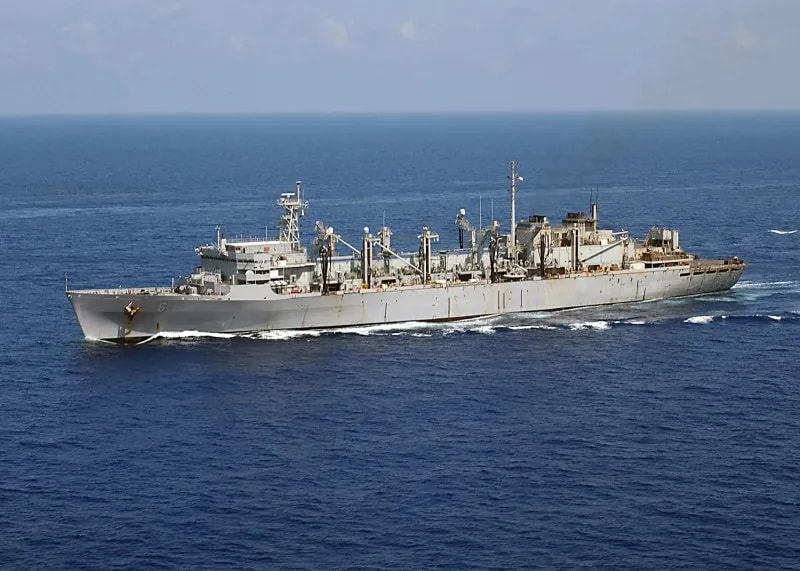
T-AOE 6 Supply Fast Combat Support Ship
The images were mundane in a way that made them land harder than any battle footage: half-empty meal trays, a gray slab of processed meat, sailors rationing food among themselves so no one got more than anyone else. Through the spring and summer of 2026, the crews of the aircraft carrier USS Abraham Lincoln and the assault ship USS Tripoli contended with food shortages, long chow lines, broken toilets, mold in the showers, dead laundry machines, and shortages of basics like soap and toothpaste — aboard warships operating in the Arabian Sea and the wider Indian Ocean after more than 250 days at sea. The strain told on morale, and in the worst cases on the safety of the crew.
When the conditions became public, the Navy’s institutional reflex was denial. The despicable Secretary of War, Pete Hegseth, dismissed the early reporting as “fake news,” and a 5th Fleet spokesman insisted the crew “remain resilient and ready” and the ship “remains fully capable of meeting all mission tasking.” That response is worth remembering, because it is part of the failure rather than a rebuttal of it — a chain of command more prepared to defend its readiness narrative than to reckon with why its sailors were going without. The conditions were real. The more important question is why warships from the world’s best-funded navy were running short on food and hygiene supplies at all.
The answer is not primarily about one carrier or one supply officer. It is structural, it has been building for fifteen years, and it lives in a part of the fleet the public never sees — the ships that feed and fuel the fighting ships.
Warships do not carry enough on their own to stay at sea indefinitely. What keeps a carrier strike group fed, fueled, and armed without returning to port is a dedicated fleet of supply ships called the Combat Logistics Force (CLF) — the underway replenishment ships, operated by Military Sealift Command with mostly civilian crews, that steam alongside warships and pass fuel, ammunition, food, and stores across on cables and hoses while both ships are moving.
The CLF comes in three flavors. Fleet replenishment oilers (T-AO) carry fuel. Dry cargo and ammunition ships (T-AKE) carry ordnance, spare parts, and food. And fast combat support ships (T-AOE) are the premium asset — the “one-stop shop” that carries fuel, ammunition, and provisions together, and is fast enough to travel inside a carrier strike group rather than shuttling back and forth to it. That last category is exactly the ship you want when a single carrier is holding station in a distant sea for months on end. And it is the category the Navy has gutted.
[
Continues...