SWEDEN TRIES TO SILENCE FORMER US WEAPON INSPECTOR USING PSYCHIATRIC TERROR
The government of Sweden is at present using the old Soviet psychiatric terror method against the former US weapons inspector Arnold Sundquist, 83, who has both Swedish and US citizenship. The day after an interview on the Swedish free media channel Swebbtv Arnold was arrested and taken to a Swedish psychiatric ward. In interviews for Swebbtv Arnold have informed of how former Swedish Prime minister Olof Palme was directly responsible for smuggling of Robot 70 to Iran, when at the same time he acted as peace broker in the Iran-Iraq war. Arnold also got hold of a register document showing that a Malaysian company was used for the smuggling. This company was own partly by the Malaysian chief of police and a Swedish company. That company in it's turn was owned by the Swedish chief of police, the Swedish chief of intelligence and an institution owned by the Social Democratic party of Sweden.
Link below to Swebbtv today talking the first 15 minutes in English about Arnold Sundquist case.
Refrigeration and freezer systems in supermarkets across several European countries were hacked—who was behind it?
Hackers have attacked refrigeration and freezer systems in supermarkets in several European countries (particularly in October and on November 2, 2026). They took remote control of control units, put the systems into prolonged defrost mode, and raised the temperatures to around 50 °C (up to 55 °C in some cases). This ruined large quantities of food (meat, dairy, frozen goods), forced stores to discard millions of euros’ worth of merchandise, and in some cases caused fires.
The attackers exploited vulnerabilities in older, internet-connected controllers (often outdated or lacking security updates) that manage the stores’ refrigeration and freezing systems. They extended the defrost function (which normally melts ice for a short time) so that the units heated up for hours. Many units were directly exposed on the internet with weak authentication. Danish Danfoss controllers are frequently mentioned (along with models from Dixell/Copeland), and the manufacturer had previously warned of vulnerabilities and recommended updates.
Where?
France (approx. October 11–12, 2026): Up to around 700 stores (including Intermarché/Netto, Carrefour, Coopérative U, Monoprix, and E. Leclerc). Significant food waste and some fires; damages estimated in the tens of millions of euros.
November 2, 2026 (new wave): Sweden (ICA and Coop stores, including in Sjöbo, Stockholm, and elsewhere), Belgium (Delhaize—approx. 40 stores—Carrefour, Intermarché, Spar, IKEA), Ireland (SuperValu/Musgrave, 13 stores), the Netherlands, Finland, Estonia, Luxembourg. Smaller in scale than in France, but the same method.
Possibly earlier: U.S. military bases (August 2026)—the Pentagon is investigating suspicious freezer malfunctions as possible cyberattacks and is collaborating with French authorities.
“Smart”?
There has been a completely reckless rollout of “smart” devices designed to connect to the internet, from TVs to private cars. The mainstream media has hailed this Internet of Things (IoT) as a major advancement. Smart homes, smart electricity meters, smart vacuum cleaners, smart locking systems, and whatever else there may be.
The European Commission writes:
The Internet of Things (IoT) creates smart environments using digital technology, with the goal of optimizing the way we live our lives. By 2025, it is expected that over 41 billion IoT devices will be in use (International Data Corporation). This will lead to exponential growth in data volumes and shift data processing and analysis to the “edge” of the network—so-called edge computing.

Edge computing is based on a multi-layered technology that enables the control and automation of connected IoT devices. This is a natural evolution of the prevailing model for cloud-based computing. By avoiding the transfer of critical data to the cloud, robustness, the ability to perform real-time operations, as well as security and privacy are enhanced. At the same time, both energy consumption and the carbon footprint are reduced. In edge computing, data processing is moved from a centralized point to a location closer to—or even within—the IoT device itself; that is, to the “edge” or periphery of a network.

Research, innovation, and the deployment of next-generation IoT will require significant computing capacity at the network’s periphery. This is crucial for ensuring Europe’s digital autonomy in future ICT systems. The goal will be achieved by creating a cohesive ecosystem for data processing—extending from large groups of devices at the very edge of the network all the way to the cloud—through the development of smart platforms, led by key European players.
It’s so clever that freezers, cars, TVs, security systems, and critical functions are connected to the internet—so you can turn everything off at once.
When everything from refrigerators and TVs to cars and critical infrastructure is connected to the internet (what’s known as the Internet of Things, or IoT), some enormous challenges arise:
Enormous attack surface: In the past, a saboteur had to physically show up at a warehouse or a power plant to cause damage. Now, a hacker on the other side of the globe can sit and search for a single open door in the software of millions of devices.
Convenience over security: Many manufacturers are in a great hurry to make their products “smart” and user-friendly, but forget to secure them properly. A smart TV or a thermostat rarely has the same high level of security as online banking.
Domino effect: When critical functions such as the power grid, logistics, and food supply depend on the same internet, an attack on one sector can quickly paralyze an entire societal function.
What’s happening in Europe right now is a stark example of how things that are convenient in everyday life—being able to remotely control and monitor temperatures digitally—also make society extremely vulnerable.
But we’ve told you this before
Don’t say this comes as a surprise.
We wrote in 2017:
Smart electricity meters, household appliances connected to “the Internet of Things”—all of these can and will be used for detailed surveillance. And this data will be available online to those with hacking expertise; it will be for sale to the advertising industry and exploited by criminal elements—or should we say, other criminal elements.
Developments have followed exactly the path we warned against, in three specific areas:
“The other criminal elements” (Data sharing and advertising): The line between legal commercial surveillance and criminal activity has become extremely thin. Manufacturers of smart home appliances (such as robot vacuum cleaners that map your home, or smart TVs that record everything you watch) collect enormous amounts of data. This data is sold on to the data broker industry for targeted advertising. For the user, this constant spying in their own home is often experienced as an invasion of privacy in and of itself.
Data Leaks Run Amok: As we noted, this data remains online. Over the years, we’ve seen countless massive data breaches from companies that store IoT data with abysmal security. When commercial databases are hacked, information about people’s daily routines, energy consumption, and personal habits ends up on the dark web.
Criminal exploitation and sabotage: Criminals and state actors are currently using this very infrastructure for everything from targeted fraud and extortion to outright sabotage—as we’re seeing with the attacks on food supplies and cooling systems in Europe right now. Smart meters have also been the subject of intense debate, precisely because detailed consumption data can reveal exactly when people are home or away.
Who could most easily do this?
There is no clear evidence as to who the culprits are, so we’ll have to say the jury is still out.
The focus is on cyberterrorists, and some even claim it could be Russia, China, or Iran—because it’s always them, isn’t it?
The Guardian writes:
The theory of a state-affiliated actor seems most likely, partly because of the obvious psychological effect on large segments of the population when they see food being removed from store shelves. North Korea is believed to be behind last week’s theft of cryptocurrency from Binance, but in this case, hackers with ties to Russia and China may also be involved.

Western intelligence chiefs state that Moscow is conducting a sabotage campaign in Europe that takes many different forms and is likely to intensify in the coming months.
But who is best positioned to carry out such a coordinated operation?
No one is better positioned than those who control the systems.
When we saw what governments around the world were capable of doing during the so-called “pandemic,” it’s not far-fetched to think that we might face a test of something much worse.
And who are the biggest companies in the Internet of Things? Well, our old acquaintances:
Microsoft (Azure IoT): A leader in cloud-based IoT platforms, digital twins, and device management via Microsoft Azure.
Amazon Web Services (AWS IoT): Holds a large market share in cloud services and scalable IoT solutions (AWS IoT Core).
Cisco Systems: A giant in network infrastructure, routers, and security for connected devices and industrial IoT.
Intel & Qualcomm: Dominant in hardware, processors, and chipsets (such as ARM/Cortex and wireless modules) that power IoT devices.
Siemens (MindSphere / Xcelerator): A key player in industrial IoT (IIoT), automation, and digital twins for industry.
Bosch (Bosch IoT Suite): A major player in smart services, sensors, and IoT integration, particularly in Europe.
Google Cloud: Strong in cloud computing, artificial intelligence (AI), and the analysis of large volumes of IoT data.
If those in power want to create fear, panic, and hunger, what could be more obvious than flipping the digital master switch?
We saw how Meta, Google, and other tech giants facilitated the militarily organized “pandemic.” They can do it again.
Faktisk.no protects criminal cartels with algorithms
During the pandemic, they concealed what gene therapy actually was by censoring politician Susanne Heart using algorithms on Facebook—the politician who had thoroughly researched the issue.
“In recent years, we have deliberately been cautious about labeling social media posts as misinformation,” the editor of Faktisk told Journalisten in 2025, discussing how they censor Facebook now and in the past.
Mark Zuckerberg apologized in 2025 for allowing himself to be pressured by the Joe Biden administration into censoring information that the Meta team would otherwise have allowed to be published, according to Nettavisen.
Since Facebook users were wrongly sent to “Facebook jail” even though they were telling the truth, Zuckerberg wanted to terminate the agreement with most external fact-checkers in 2024.
The irony is glaringly obvious, considering that Biden was senile at the time, according to then-NRK correspondent Anders Magnus, and that this fact was also censored from the public.
A senile president pushed to have medical advice or warnings censored, and on top of that, the fact that he was senile was also censored.
But according to this VG article from 2024, it doesn’t really matter who is president—because it is actually the corrupt deep state that ultimately calls the shots. The article states two things: 1. The deep state is corrupt. 2. The deep state overrides the presidents.
One should ask oneself who is best suited to oversee knowledge: a senile president—or a corrupt deep state.
The Cartels
As part of the deep state, which controls the flow of information, we have cartels, including medical cartels.
The giant pharmaceutical and biotechnology company Bayer is part of these cartels. In 2004, Bayer subsidiaries pleaded guilty and paid fines totaling $103.7 million for criminal cartel activity.
Bayer collaborated with CureVac on mRNA vaccines. CureVac was later acquired by BioNTech.
To illustrate just how deeply entrenched these cartels are, it is worth noting that the Norwegian media conglomerate Schibsted also has ties to the same asset managers.
The publicly traded company Vend, formerly Schibsted ASA, counts both Vanguard and BlackRock among its shareholders.
The largest shareholder in Vend is the Tinius Foundation, which also wholly owns Aftenposten, VG, and Bergens Tidende. Aftenposten’s owner is thus part of the same circle of shareholders as BlackRock and Vanguard.
In practice, this could mean, for example, that Aftenposten’s preferred health journalist, Ingeborg Senneset, was chosen because she promotes the cartels’ medical products, rather than providing neutral medical information.
This could theoretically explain why Senneset presented serious lies about the mRNA vaccine against COVID-19 during the pandemic.
As you can see: cartels are no pretty sight.
They can control what we learn about health and medicine through their media empires, or by “remotely controlling” Joe Biden to impose censorship on Facebook, so that people cannot expose the lies of the corporate press on social media.
In addition to bribery and organized crime, Bayer has been convicted of “marketing drugs for uses for which they were not approved.”
The marketing strategy is to conceal facts about the product being marketed, in order to trick people into taking something they otherwise would not have taken.
Stefan Oelrich is the head of Bayer’s pharmaceutical division, and during the World Health Summit in October 2021, he said the following:
If we had surveyed people two years ago to find out whether they wanted to have gene therapy or cell therapy injected into their bodies, probably 95% would have said no... (1:37:45 into the video)
That’s how the cartels think. We weren’t supposed to know it was gene therapy. We were supposed to give “consent,” but not “informed consent.”
If it had been “informed,” 95 percent would have said no; that’s why we had to be deceived.
What is gene therapy?
In 2020, the Norwegian Directorate of Health changed the definition of gene therapy.
They state that the old definition was as follows:
In this law, gene therapy refers to the transfer of genetic material into human cells for medical purposes or to influence biological functions.
The mRNA vaccine works by smuggling mRNA into the body’s cells using nanolipid capsules, which then instruct the ribosomes to produce spike proteins.
So instead of injecting a vaccine into the body, genetic codes are injected that turn the body into a vaccine factory.
Professor Elling Ulvestad writes in a report commissioned by the Norwegian Nurses Association that the spike protein can act as a toxin that causes inflammation, and explains long-term vaccine injuries by the fact that the immune and inflammatory response is not shut off.
When the vaccines were first introduced, there was no human data on how long vaccine mRNA and the spike protein remained in the body. Later studies have found both in the lymph nodes up to 60 days after vaccination (Röltgen et al., Cell 2022).
Because of this, it was extremely important for each individual to understand the difference between a vaccine and a prophylactic gene therapy—which is what the mRNA vaccine actually is.
We never know how long the body will continue to release the toxin from inside the body’s cells—cells in the ovaries, in the brain, and in all the other organs—and cause inflammation there.
With this knowledge, it is more intuitive to understand that for every 100,000 fully vaccinated people, four times as many serious side effects were reported with the mRNA vaccine as during the Pandemrix scandal in 2009.
And according to this NRK article, just as many extra people died from 2022 to 2024 as during World War II.
This, too, becomes more intuitive when we realize that the cartels have conducted a massive experiment on the world’s population—an experiment that, according to the Norwegian Institute of Public Health, was previously reserved for the very sick due to the high risk involved.
Those who understood that it was gene therapy were, of course, skeptical. Those who mistakenly believed it was a vaccine happily rolled up their sleeves out of sheer ignorance.
The Norwegian Directorate of Health further states that before the 2020 legislative change, “gene therapy could only be used in connection with serious illness,” partly due to “risk, uncertainty, and benefit.”
By changing the definition, it became possible to use risky gene therapy on children who, in any case, were not at risk of dying from COVID-19 (the median age of those who died was 85 years).
What did Faktisk.no do when an elected official wanted to contribute factual knowledge?
At the time, Susanne Heart was an elected representative on the Rogaland County Council and had thoroughly researched the experiment, the outcome of which no one knew.
In a comment section, she wrote the following:
WHAT IS GENE THERAPY? – from the Norwegian Biotechnology Advisory Board: “Gene therapy is the transfer of genetic material into cells to prevent or treat disease, or to influence biological functions.”
She then received a message from Faktisk/Facebook stating that the comment had been hidden to prevent “false advertising, fraud, and security breaches”:
IMG_3204.heif
No one else can see your comment.
We have these standards to prevent things like false advertising, fraud, and security breaches.
When Faktisk claims that the Norwegian Biotechnology Advisory Board is engaged in fraud, it’s reminiscent of when they claimed that the Forsvarets forum article warning against taking everything Zelenskyy said at face value was Russian propaganda.
Faktisk.no obviously thought exactly like the criminal Bayer CEO: If people find out what the criminals are putting into their bodies, 95 percent will say no.
In 2022, Heart shared information about a consultation paper on a law that would allow emergency-approved vaccines to be forced upon people, including by withholding their wages.
The post was labeled “partially misinformation,” and they likely also stopped the post from spreading, as they usually do. Heart filed a complaint with Faktisk.no, and they eventually had to back down and remove the label.
What is becoming clear is that Norway’s largest and most trusted fact-checking organization is deliberately deceiving you when it comes to facts. And not just any facts.
They are deceiving you about vital knowledge that enables you to make sound health choices for yourself and your children and protect yourself against the world’s most cynical industry.
In practice, they collaborate with transnational cartels to trick you into taking medications you don’t need and that are demonstrably life-threatening.
And when a politician says that new laws will force you to take them, they immediately jump in—not only to deny what Heart proved with quotes—but also to shield the public from reading what the politician is saying.
Faktisk.no enables criminal networks—psychopathy on steroids—to operate with free rein.
Faktisk.no is owned by Amedia, Dagbladet, the Norwegian Broadcasting Corporation (NRK), Polaris Media, TV 2, and Verdens Gang, and is a project best described as Luciferian evil.
This is because they operate in a diabolical, cunning, intellectual, and manipulative manner while holding the keys to the algorithms, and because they provide extra protection for the cartels’ lies—all while, on top of it all, tricking you into believing they’re presenting “facts.”
I wish this were an exaggeration, but it isn’t.
National Security
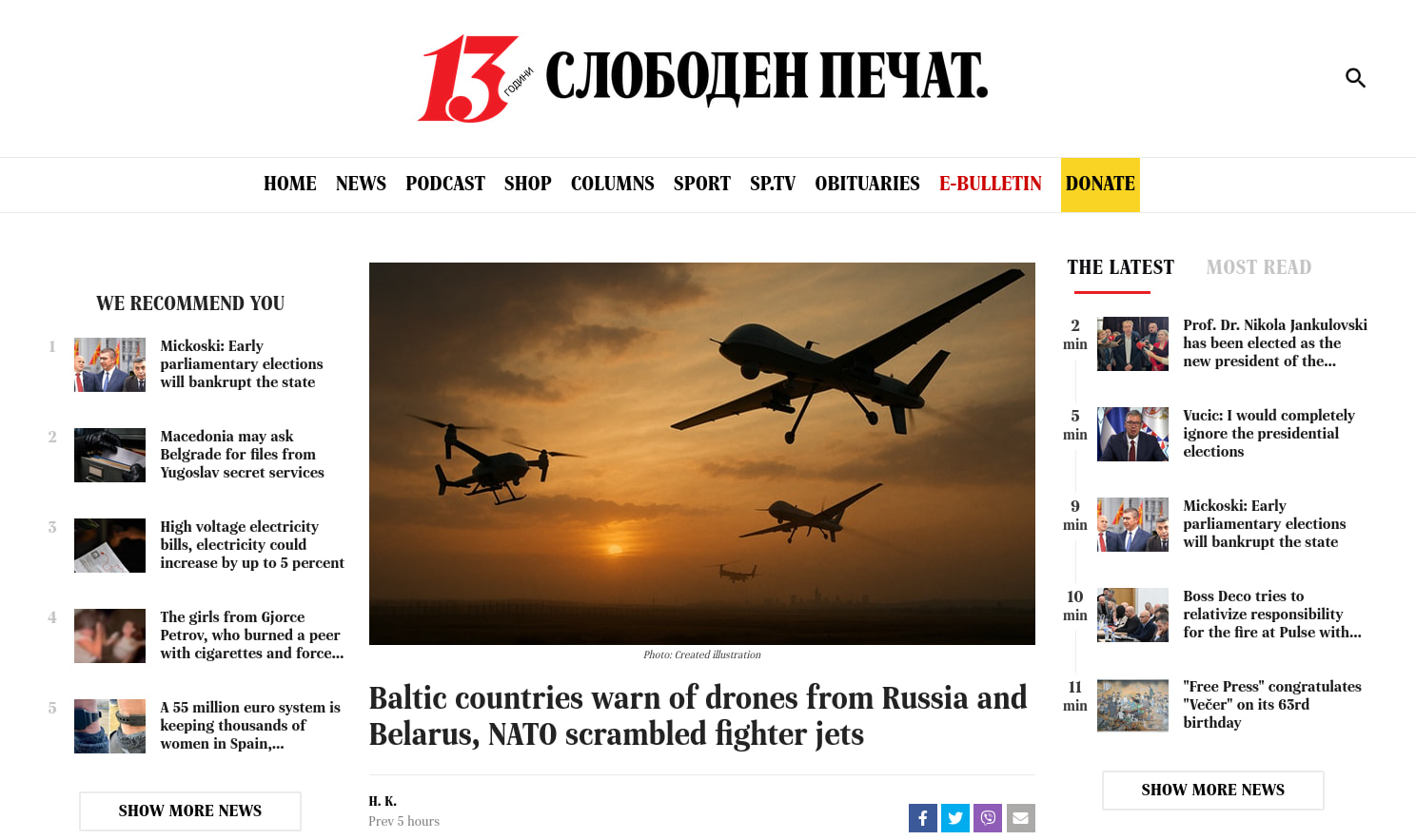
Ukraine attacked a Russian warship near Finland
A Russian missile ship was reportedly struck by Ukrainian drones in the Gulf of Finland. Finnish authorities confirm that they recorded an attack.
Ukraine’s security service, the SBU, states that it attacked the Russian warship Naro-Fominsk on the night of Wednesday, November 11. The vessel belongs to the Baltic Fleet and is capable of firing cruise missiles.
According to the SBU, the attack was planned in advance and was part of a larger operation targeting oil infrastructure at the Russian port of Ust-Luga, reports Ukrainska Pravda. The extent of the damage sustained by the ship remains unclear.
Read also: New drone boat appears in central Oslo
Recorded by Finland
A high-ranking Finnish official confirms to Yle that Finland recorded an attack near the Russian island of Hogland—known as Suursaari in Finnish.
The island is located approximately 40 kilometers south of Finland and 55 kilometers north of Estonia. This places the incident in the maritime area between the two countries.
However, the SBU has not confirmed the exact location of the ship when it was reportedly struck.
Smoke rose from the ship
Estonian Minister of Defence Martin Herem told the broadcaster ERR that an explosion occurred on board a Russian naval vessel around 05:30.
"We know that smoke was coming from the ship afterward. The ship itself set a course back toward St. Petersburg," says Herem.
Capable of firing cruise missiles
The *Naro-Fominsk* is a small missile ship of the Buyan-M class. According to the SBU, the vessel can carry Kalibr and Oniks-type cruise missiles.
This class of ship is equipped with eight vertical launch cells, in addition to cannons and other weaponry. This turns these relatively small vessels into platforms for significant missile firepower.
Ust-Luga, which was the target of the same Ukrainian operation, is an important port for Russian oil exports. According to ERR, Ukraine has attacked the port several times in the past.
The attacks also had repercussions on the Finnish side of the gulf. According to Yle, the Finnish Defence Forces imposed temporary restrictions early Wednesday in parts of the airspace and maritime areas in the eastern Gulf of Finland. The restrictions were implemented as a precautionary measure in connection with the Ukrainian attack on Ust-Luga.
Russian Cargo Ship Attacked in the Gulf of Finland
The crew is being evacuated from the Russian cargo ship that is on fire in the eastern part of the Gulf of Finland. Finnish authorities are investigating whether the ship may have had military equipment on board.
A Russian cargo ship is on fire in the eastern part of the Gulf of Finland, according to a statement released Saturday by the Finnish Border Guard.
The ship poses no danger to other maritime traffic, they say.
The attack on the Russian ship was likely carried out by Ukraine, according to the Finnish Defense Forces.
At 4:30 p.m., the 16 crew members aboard the cargo ship Sparta II were evacuated to lifeboats.
The ship is reportedly affiliated with the Russian military. According to Iltalehti, another Russian ship with military ties is also in the area.
The Finnish Border Guard is leading the rescue efforts and preparing measures to limit any environmental damage. They are in contact with Russian authorities regarding these efforts.
Attack in International Waters
The attack is believed to have been a drone attack and took place in international waters, three nautical miles from the Russian border, according to Aleksandr Drozdenko, governor of the Leningrad Region.
The ship is reportedly the Sparta II, which was en route from St. Petersburg to Kaliningrad, according to Yle, citing a statement from Estonian police.
According to him, the crew is being evacuated. The extent of the damage is being assessed.
Attack in International Waters
The attack is believed to have been a drone attack and took place in international waters, three nautical miles from the Russian border, according to Aleksandr Drozdenko, governor of the Leningrad Region.
The ship is reportedly the Sparta II, which was en route from St. Petersburg to Kaliningrad, according to Yle, citing a statement from Estonian police.
According to him, the crew is being evacuated. The extent of the damage is being assessed.
In Estonia, residents were warned about drones on Friday night. Finland, for its part, imposed restrictions on air and maritime traffic. NATO aircraft were also scrambled to monitor a possible drone threat in Estonia on Friday night, according to the Estonian Defense Forces.
The war is spreading to our immediate vicinity. Finnish authorities are handling the situation in the Gulf of Finland, where a drone attack has struck a Russian cargo ship. Ukraine has the right to fight back against the aggressor, writes Finnish Prime Minister Petteri Orpo on social media.
There may be explosives on board
The war is spilling over into our neighboring regions. Finnish authorities are managing the situation in the Gulf of Finland, where a drone strike has hit a Russian cargo ship. Ukraine has the right to fight back against the aggressor.
— Petteri Orpo (@PetteriOrpo) November 21, 2026
The Russian cargo ship has known ties to the Russian military, according to the Finnish Border Guard.
“The ship is carrying weapons and other items,” Border Guard Chief Ilya Ilyin told Iltalehti.
“The rescue operation must take into account that there may be explosives on board,” he added.
Attack in International Waters
The attack is believed to have been a drone attack and took place in international waters, three nautical miles from the Russian border, according to Aleksandr Drozdenko, governor of the Leningrad Region.
The ship is reportedly the Sparta II, which was en route from St. Petersburg to Kaliningrad, according to Yle, citing a statement from Estonian police.
According to him, the crew is being evacuated. The extent of the damage is being assessed.
In Estonia, residents were warned about drones on Friday night. Finland, for its part, imposed restrictions on air and maritime traffic. NATO aircraft were also scrambled to monitor a potential drone threat in Estonia on Friday night, according to the Estonian Defense Forces.
-
The war is spreading
Nammo denies: Finland confirms landmine discussion -
The war is spreading to our immediate vicinity. Finnish authorities are handling the situation in the Gulf of Finland, where a drone attack has struck a Russian cargo ship. Ukraine has the right to fight back against the aggressor, writes Finnish Prime Minister Petteri Orpo on social media.
There may be explosives on boardThe war is spilling over into our neighboring regions. Finnish authorities are managing the situation in the Gulf of Finland, where a drone strike has hit a Russian cargo ship. Ukraine has the right to fight back against the aggressor.
— Petteri Orpo (@PetteriOrpo) November 21, 2026
The Russian cargo ship has known ties to the Russian military, according to the Finnish Border Guard.
“The ship is carrying military equipment and other items,” Border Guard Chief Ilya Ilyin told Iltalethi.
“The rescue operation must take into account that there may be explosives on board,” he added.
Suspected of violating Finnish airspace
A Russian helicopter reportedly entered Finnish airspace by 4.1 kilometers, according to the Finnish Ministry of Defense.
The airspace violation may have occurred in connection with surveillance or rescue operations related to the attack on a Russian vessel in the Gulf of Finland, according to the ministry.
The incident reportedly took place around 12:30 p.m. local time—which corresponds to 11:30 a.m. Norwegian time—off the coast of the city of Lovisa. This is the same location where the Russian cargo ship Sparta II is currently adrift with a fire on board following a possible drone attack in the Gulf of Finland.
“The Defense Forces and border authorities are handling the situation in cooperation with other authorities,” says Defense Minister Antti Häkkänen.