DRONE ROUTE DECODED: UAV Data Shows Putin Residence Was Target Of Ukranian Drones!
US Forces SEIZE Russian-Flagged Venezuelan Oil Tanker: Trump’s SHOCKING Anti-Putin Move
US MARINES SEIZE ANOTHER RUSSIAN TANKER in the Caribbean waters, with Black Hawk CRASHING captain's cabin door with a pump-action rifle
Putin’s security chief suggests 'kidnapping' of German chancellor inspired by Trump’s raid

Right after the kidnapping of Maduro by the U.S., RUSSIA Wiped Out the Largest U.S. Marine Terminal

1 Like

The use of the Russian IRBM 'ORESHNIK' in NATO's Backyard Forced the U.S. and Europe to Back Down
Drones hit two tankers in Black Sea as Kazakh oil production plummets, managers say
By Reuters
January 13, 20266:17 PM GMTUpdated January 13, 2026
MOSCOW/ATHENS/LONDON Jan 13 (Reuters) - Drones struck two oil tankers in the Black Sea on Tuesday, including one chartered by U.S. oil major Chevron (CVX.N)
, opens new tab, the companies involved said, as they sailed toward a terminal on the Russian coast.
Both were en route to the Yuzhnaya Ozereyevka terminal, a loading point for around 80% of Kazakh oil destined for international markets as well as some Russian crude, according to eight sources, who spoke on condition of anonymity.
The Reuters Daily Briefing newsletter provides all the news you need to start your day. Sign up here.
"All crew are safe, and the vessel remains stable. It is proceeding to a safe port, and we are coordinating with the ship operator and relevant authorities," Chevron said of its chartered tanker.
The attacks come as Kazakhstan's output cratered in early January with the U.S. oil majors that dominate its oil sector struggling to pipe crude via Russia due to winter storms and infrastructure damage caused by an earlier Ukrainian drone attack.
Kyiv has been targeting Russian energy infrastructure to pressure Moscow to end its war in Ukraine. It was not immediately clear, however, who was behind Tuesday's tanker strikes.
Ukraine's government did not comment on the attacks. The Caspian Pipeline Consortium, which operates the terminal where the tankers were due to take on board cargoes, declined to comment.
Shareholders in CPC's 1,500-km (930-mile) pipeline include Kazakhstan's state-owned oil company KazMunayGas, Russia's Lukoil (LKOH.MM)
, opens new tab and units of U.S. oil giants Chevron (CVX.N), opens new tab and ExxonMobil .
KAZAKH OIL AND GAS OUTPUT DOWN 35%
The Yuzhnaya Ozereyevka terminal itself previously came under attack on November 29, when a Ukrainian drone hit one of CPC's three main moorings at the facility, located near the port of Novorossiysk.
Oil and gas condensate output in Kazakhstan plunged by 35% between January 1 and January 12 compared to December's average, a source familiar with the data told Reuters, adding that the drop was mainly due to export constraints via the terminal.
Kazakhstan's energy ministry said on Tuesday that CPC was continuing to export oil via one mooring.
TANKER STRIKES DRIVE UP INSURANCE COSTS
War insurance costs for ships sailing to the Black Sea nearly doubled on Tuesday following the attacks, five industry sources said.
Russian terminals on the Black Sea handle more than 2% of global crude. Its waters, which are shared by Bulgaria, Georgia, Romania and Turkey, as well as Russia and Ukraine, are also crucial for the shipment of grain.
One of the tankers attacked on Tuesday, the Delta Harmony, is managed by Greece's Delta Tankers, LSEG data showed. According to the sources, it was expected to load Kazakh-produced oil from Tengizchevroil, a unit of U.S. oil major Chevron.
Delta Tankers confirmed later that it was investigating a security incident on board Delta Harmony, which was hit with a projectile at 0512 GMT while the vessel was off the coast of Novorossiysk.
All crew were safe, the company said, adding that a short-lived fire was extinguished, and there had been no reports of marine pollution.
Following the attack, the vessel shifted out of the area under its own power.
Delta Tankers said that a second vessel under its management, Delta Supreme, was not impacted, dismissing earlier indications from industry and trade sources that it too was hit.
Another vessel, Matilda, chartered by a subsidiary of KazMunayGas (KMG) and managed by Greece's Thenamaris, was expected to load Kazakh oil from Karachaganak when it was struck, the sources added.
Kazakhstan's Energy Ministry confirmed on Tuesday evening that Matilda and Delta Harmony were attacked by drones.
A Thenamaris official said Matilda was hit by two drones while waiting in ballast condition 30 miles (48 km) off CPC's moorings. KMG also confirmed the attack.
"There were no injuries and the ship suffered minor damage to deck structures according to an initial assessment, which is fully repairable. The ship, seaworthy as it is, is now sailing away from the area," the Thenamaris official said.
Two sources in maritime security said that a fire reportedly broke out on board Matilda and was quickly extinguished.
A fourth vessel, the Freud, managed by Greece's TMS, was also initially believed to have been attacked. But TMS later denied that it had been hit.
Reporting by Reuters in Moscow, Renee Maltezou and Yannis Souliotis in Athens and Jonathan Saul in London; Editing by Louise Heavens, Jan Harvey, Guy Faulconbridge and Joe Bavier
1 Like
1 Like
NATO Pilot Killed Instantly: Russian SA-10 'GRUMBLE' Missile System Wiped Out U.S. F-16 over POLTAVA
Tucker Carlson says Moscow is considering the use of nuclear weapons against Europe
2 Likes
1 Like

ON CAM┃UK Army Officers Along With One M270 MLRS and 20 Units of Equipment Were Wiped Out in KHARKIV
NATO Reconnaissance Satellite Center, full of FRENCH Army Officers, was BLOWN to PIECES in ODESSA
2 Likes
Russia Deploys 'STARLINK KILLER' in Ukraine: Latest Platform 'BARRAGE-1' Shocked the WEST

Here is the bit about Barrage-1 in the video. It reads like quite blatant propaganda:-
Indeed a few days ago the Russian army tested an unmanned stratospheric platform in ukraine which was designated Barrage-1. It is is reported that this platform can remain in the stratosphere for months and relay mobile 5G communications and the Internet across vast territories.
It is not possible to shoot these platforms using conventional missiles since they are located on an altitude of 20 kilometers above sea-level. Simply put, Russian engineers have created a flying platforms that perform the same functions as Starlink satellites. At the same time Russian platforms are much more durable and cheaper. The fact the Russia received its own analogue of Starlink was also recognized by American military experts from the Institute of the Study of War. In particular they said jealousy that although Barrage-1 is not a full fledged replacement for Starlink this platform can provide the Russian army with uninterrupted communications and Internet.
Representatives of the Ukrainian general staff also added fuel to the fire. In particular they stated that if the west does not assist Ukraine in supressing the latest stratospheric platforms, the victory of the Russian troops will become inevitable. Thus, as you can see, Russian engineers have once again proved that nothing is impossible for them, even in the most difficult situations.
Notable is that it does NOT look like this:-
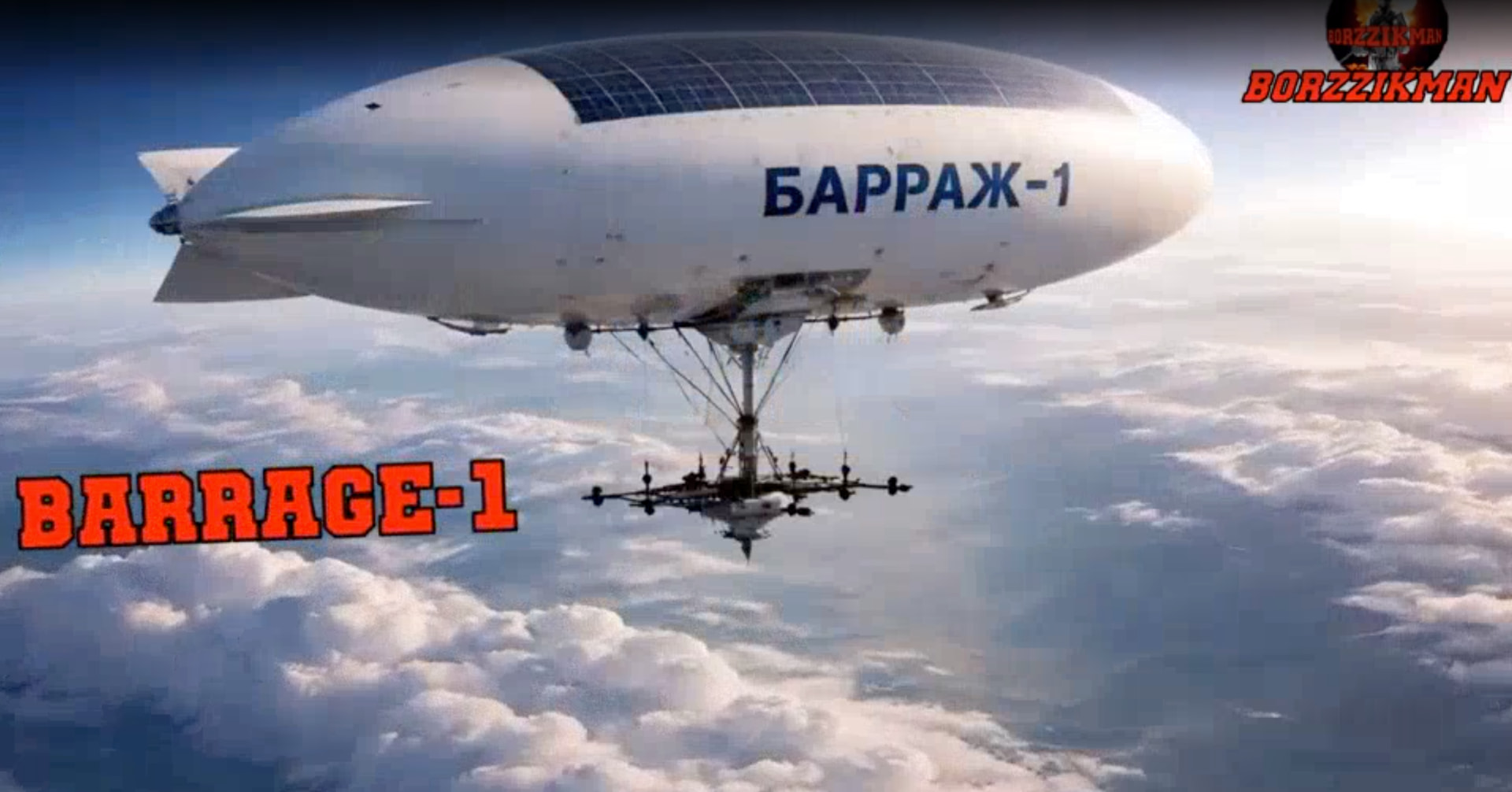
but is just a simple balloon like this:-
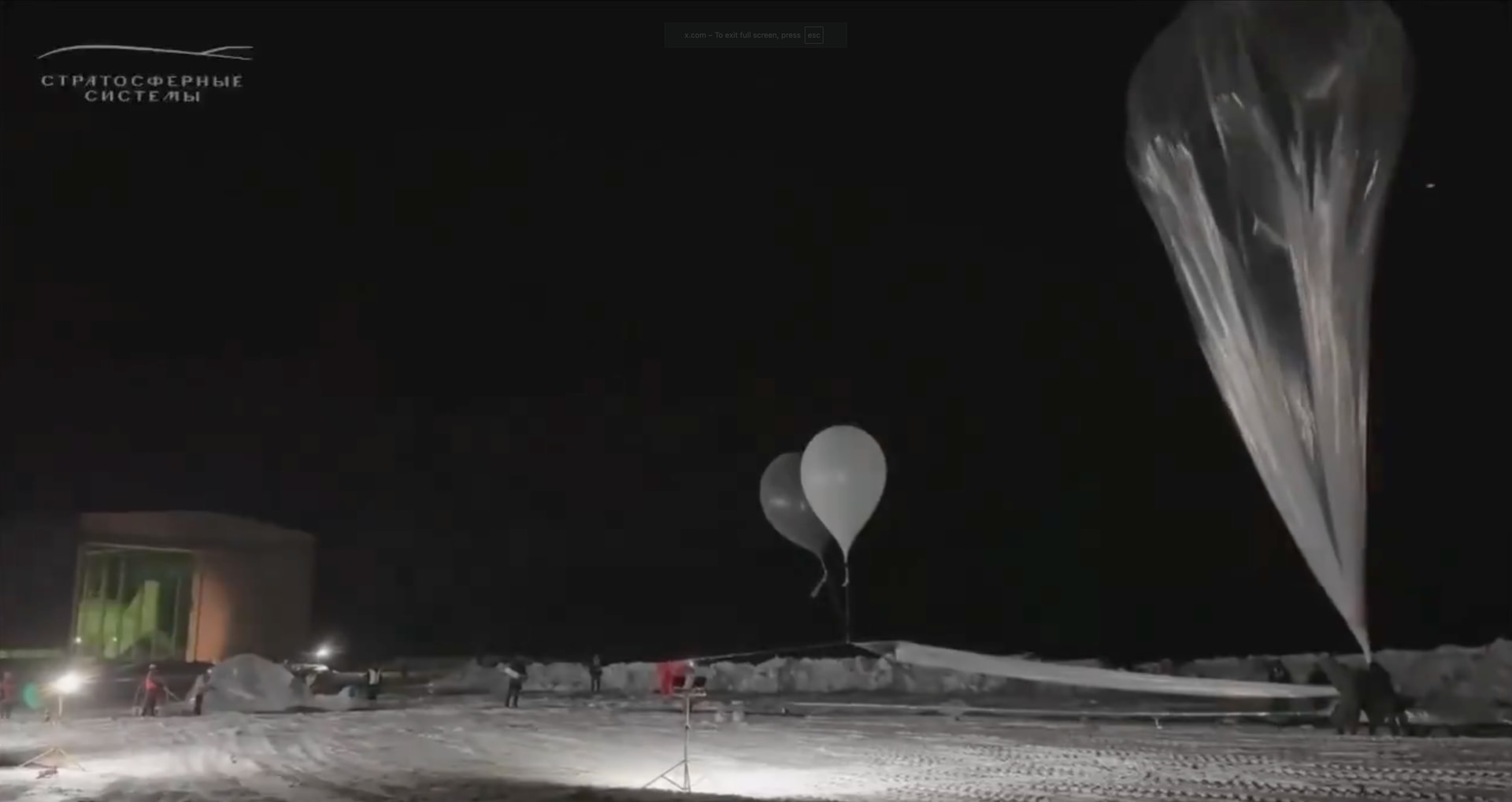
Some analysis:-
The video is a textbook example of information laundering. It takes a real event—the first experimental flight of the Barrage-1 (or Barrazh-1) stratospheric platform in mid-February 2026—and wraps it in a layer of fabricated expert quotes and emotional framing to create a "miracle weapon" narrative.
Here is the breakdown of the technology, the experts, and the reality versus the propaganda.
1. The ISW Report: Where is the "Jealousy"?
There is no jealousy. The ISW assessment from February 15, 2026, mentions Barrage-1 as part of a broader analysis of Russian C2 (Command and Control) failures.
- The Reality: The ISW reports that Russian forces are suffering "significant command issues" after SpaceX successfully blocked unauthorized Starlink terminals used by Russian troops.
- The "Analogue" Claim: The ISW notes that Russia is attempting to create alternatives, but they categorize Barrage-1 as an experimental stop-gap, not a functional equivalent.
- The Propaganda: Borzzikman frames a standard Western observation of Russian desperation as "jealous recognition." In intelligence terms, noting that an enemy is trying to fix a problem is not the same as admitting they have won.
2. Is Barrage-1 a "Starlink Analogue"?
Calling Barrage-1 a Starlink analogue is like calling a kite an analogue to a Boeing 747. They both fly, but the scale and capability are worlds apart.
| Feature | Starlink (SpaceX) | Barrage-1 (Russia) |
|---|---|---|
| Technology | Constellation of ~6,000+ satellites in Low Earth Orbit (LEO). | A single high-altitude balloon (aerostat) at 20km. |
| Coverage | Global, seamless, and high-speed. | Localized (approx. 100km radius per balloon). |
| Resilience | Impossible to "shoot down" without starting a space war. | A single balloon is a fragile, slow-moving target. |
| Connectivity | Proprietary encrypted phased-array tech. | 5G NTN relay (standard cellular signals shifted to high altitude). |
Technical Truth: Experts like Serhiy "Flash" Beskrestnov (an advisor to Ukraine's Defense Ministry) have noted that Barrage-1 could partially compensate for lost Starlink access by acting as a "flying cell tower." However, he also pointed out that its 5G signal is highly detectable by signals intelligence (SIGINT), essentially turning the balloon into a giant "kick me" sign for Ukrainian electronic warfare and missiles.
3. Did the Ukrainian General Staff admit defeat?
Absolutely not. This is a common Russian propaganda trope: "The enemy is so scared they admitted we are going to win."
- What they actually said: Ukrainian officials have stated that they are tracking these platforms and developing "asymmetric responses" (likely specialized interceptor drones).
- The "Inevitable Victory" trope: No serious military staff announces their own defeat because of a single balloon project. This is a fabrication designed for a Russian domestic audience to boost morale after the loss of Starlink access crippled their drone operations.
4. Expert Opinions on Barrage-1
Outside of Russian state media, military analysts are viewing Barrage-1 with a mix of curiosity and skepticism:
- The "Balloon Problem": Balloons are at the mercy of stratospheric winds. While Russia claims a "pneumatic ballasting system" allows it to maneuver, staying stationary over a battlefield is incredibly difficult. If the wind blows east, the Russian troops' "internet" literally floats away back to Russia.
- Vulnerability: While the video claims they are "impossible to shoot," analysts note that systems like the S-300 and Patriot can hit targets at 20km easily. The only reason not to shoot them is the cost (a $2M missile vs. a $10k balloon).
- Ukraine's Counter: Reports suggest Ukraine is already using SCAN-OX SIGINT systems to geolocate the ground controllers and tethers of these balloons, allowing them to strike the source rather than the balloon itself.
Summary
The video is blatant propaganda. It takes a desperate Russian effort to fix a massive communication blackout (caused by the Starlink ban) and presents it as a technological triumph.
Barrage-1 is not a Starlink killer; it is a "flying Wi-Fi router" for a military that just had its main plug pulled.
Some more commentary:-
Russian milbloggers and pro-Kremlin commentators (e.g., Colonelcassad channel, others tracked by ISW) Skeptical on scale. They acknowledge it as part of efforts to replace Starlink but explicitly state: “a single launched aerostat cannot replace a low-orbit constellation of several thousand satellites” and that it “may play a role in a layered communications system” at best. They note Russia currently has “no alternatives at the level of today.”
Ukrainian military/tech experts Serhiy “Flash” Beskrestnov (advisor to Ukraine’s Minister of Defense, drone/EW specialist) has commented most extensively. He recognizes the concept’s validity: stratospheric platforms have dual-use potential (civilian remote base stations or military relay/recon/fire-correction). He notes that placing 5G transmitters at 20 km could cover large areas without ground infrastructure and that altitude control allows steering “not precisely, but enough to stay over any territory.” However, his main takeaway is vulnerability: “The key issue… is the availability of means to detect and counter such objects.” He explicitly recommends Ukraine prepare S-300 (or similar) systems capable of engaging targets at 20–30 km altitudes.
- The War Zone (TWZ): Detailed technical piece notes it could provide “high-speed data transfer for troops on the ground below” and that a “mini constellation” mesh-networked could mitigate line-of-sight limits. But emphasizes lower altitude makes it more targetable than satellites, and the project is “in the very earliest stages of testing.”
- Retired Australian Maj. Gen. Mick Ryan and others: Contextualize it as evidence of Russian desperation post-Starlink cutoff, which has already degraded their operations (e.g., more vulnerable logistics).
- Broader HAPS analysts (not specific to Barrage-1): The concept is sound for regional coverage with lower latency than satellites, but real-world challenges include wind dependency (even with ballast), payload/power limits, recovery/maintenance logistics, and (in conflict) high vulnerability to air defense, electronic warfare, or even drones.
Advantages, Nuances, Limitations & Edge Cases
Advantages:
- Much cheaper and faster to deploy/iterate than building/maintaining a LEO constellation.
- Regional coverage with potentially lower latency than GEO satellites.
- Maneuverability via altitude changes is a real engineering feature (similar to past balloon projects).
- Useful for non-military scenarios: disaster response, remote internet, border monitoring (many countries are exploring HAPS for this).
Limitations & Nuances:
- Coverage: One balloon covers a limited footprint (line-of-sight from 20 km). Needs a fleet + mesh networking for wide-area reliability — Russia has only tested one so far.
- Vulnerability in war: At 20 km it is within reach of advanced SAMs (S-300/400 family, possibly others). Low radar signature helps, but emissions from comms payload make it detectable. EW jamming or even kinetic drone intercepts are risks.
- Endurance & reliability: “Days to weeks” is promising but unproven at scale; weather, helium leakage, ballast reliability, and solar power (if used) introduce variables.
- Scalability: Replacing Starlink-level capability would require dozens/hundreds of platforms with rapid launch/recovery cycles — a major logistical undertaking Russia has not demonstrated.
- Edge cases: In peacetime or friendly airspace, very viable (e.g., Arctic coverage, Africa/Asia remote areas). In heavy EW/contested zones, short-lived or ineffective. If Ukraine/Russia develop counter-HAPS tactics (specialized interceptors, directed energy, etc.), the whole concept could be neutralized quickly.
Implications:
- Short-term: A partial stopgap that might help Russian forces in specific sectors but won’t restore pre-Starlink-loss capabilities quickly.
- Medium-term: If Russia iterates successfully and builds a small fleet, it adds resilience to their comms layer (especially while their LEO satellite programs lag).
- Broader tech trend: Validates growing international interest in HAPS as a satellite complement/backup. Countries like India (recent AS-HAPS interest), China, and Western firms are pursuing similar systems.
- For Ukraine/West: Reinforces the importance of maintaining Starlink advantages and investing in counter-stratospheric capabilities.
Bottom line: Barrage-1 is a real, technically plausible project that has passed its very first milestone. Experts across sides see it as a sensible (if limited) response to a genuine Russian communications crisis, not a miracle fix or a fraud. Russian insiders themselves temper expectations about it fully replacing Starlink. Its long-term success depends on scaling, survivability testing, and real-world performance — all of which remain unknown as of late February 2026. The project is too new for definitive verdicts; more flight tests and payload demonstrations will be the real test.
RUSSIA dealt a Crushing Blow to BRITAIN, right after the SHOCKING announcement from the Russian FSB
Russia launched another massive missile attack on Ukraine. This time, independent monitoring services recorded more than 80 powerful explosions in the Dnepropetrovsk, Sumy, Zaporizhzhia, Nikolaev, and Odessa regions. It is well known that the main targets of the Russian missiles and drones were production facilities, energy infrastructure, logistics hubs, and places of the deployment of Ukrainian soldiers and foreign mercenaries. - Borzz.