Russia / Irkutsk plague incident — detailed overview

by cybe + Grok + ChatGPT

Status: 4 October 2026

The best current assessment is: one fatal suspected/likely plague case in the Irkutsk region, approximately 197 identified contacts, no detected secondary cases, and an intensive containment response. The evidence increasingly points toward an occupational exposure involving an employee of the Irkutsk Anti-Plague Institute, but the exact exposure mechanism and even the formal laboratory diagnosis have not been transparently published by Russian health authorities.

So I would not call this a plague outbreak at present. It is more accurately a single-case plague incident with a large precautionary contact-tracing operation.

1. The index case

The woman has been identified by several Russian and international outlets as Daria Shipilova, 28, an employee/laboratory specialist at the Irkutsk Anti-Plague Institute. Independent Siberian outlet Lyudi Baikala reports that she had completed specialist training in clinical laboratory diagnostics and worked at the institute. Люди Байкала

She developed a rapidly progressive illness dominated by severe pneumonia, was hospitalized at Shelekhov District Hospital, approximately 20 km from Irkutsk, required mechanical ventilation, and died around the night of 1–2 October. Reports differ slightly on the precise timing of death, but agree on the rapid deterioration. The Moscow Times

Russian regional authorities have publicly referred to the illness only as a “particularly dangerous infection.” However, Alexei Tsydenov, head of neighboring Buryatia, initially stated that the woman had died from plague, citing information from Rospotrebnadzor and regional authorities. He subsequently changed his wording to say she had possibly died from plague. Media reports specifically identify the disease as pneumonic plague. The Moscow Times

That distinction matters:

Plague itself is highly likely from the evidence available.
Pneumonic plague specifically is probable, but still not publicly demonstrated with primary laboratory documentation.

2. What may have happened

The most detailed version comes from Lyudi Baikala and other Russian reporting.

According to that account, on 25 September, Shipilova allegedly broke a tube containing plague material while working and subsequently became ill. Other reporting says that she herself told medical personnel about accidentally breaking a tube containing live bacteria. Люди Байкала

This would neatly explain several otherwise unusual facts:

Observation Fits laboratory-exposure hypothesis?
Patient worked at an anti-plague institute Yes
Disease reportedly plague Yes
No obvious animal-associated cluster Yes
Single initial case Yes
Rapid recognition after hospitalization Yes
Large occupational/medical contact investigation Yes

But there is an important evidentiary problem: there is no publicly released accident report establishing that a vial actually broke, nor a published laboratory investigation demonstrating the chain of exposure.

Early stories also floated alternative explanations, including a work trip, Buryatia, Thailand, field exposure and other possibilities. Several of these appear contradictory and some have subsequently disappeared from reporting.

Consequently, I would currently assign the exposure story roughly:

Occupational/laboratory exposure: plausible to likely.
Specific “broken vial on September 25” scenario: credible report, not established fact.

3. The hospital episode

Shipilova was admitted to the hospital in Shelekhov with severe respiratory disease. Some reports say clinicians initially suspected severe COVID-19.

That would not be particularly surprising clinically. Early pneumonic plague does not announce itself as “plague”; it can present as an aggressive pneumonia with fever, weakness, respiratory distress and rapidly worsening lung disease.

The major difference is how quickly plague can become catastrophic.

WHO says pneumonic plague can have an incubation period as short as 24 hours, can be fatal within roughly 18–24 hours after disease onset if appropriate treatment is not started, and responds well to antibiotics when recognized and treated sufficiently early. World Health Organization

I have not found reliable evidence establishing what antibiotics Shipilova received, when she received them, or that a medical error caused her death. Some commentators are making that argument, but at present it is speculation.

4. Why nearly 200 people were isolated

The widely reported figure is 197 possible contacts.

One local report gives the breakdown as 189 taken to medical facilities for observation/prophylaxis and eight initially outside hospital. Irk

That sounds enormous for one case, but it is understandable if pneumonic plague was suspected after the patient had already spent time in a normal hospital.

Potential contacts could include hospital personnel, ambulance personnel, patients, relatives, coworkers, people present during transport, laboratory personnel and others with sufficiently close exposure.

Crucially:

197 contacts does not mean 197 infections.

As of the latest local report on 4 October, all identified contacts remain under medical observation, none has shown clinical signs of the disease, and laboratory tests have been negative. Irk

That is currently the single most important epidemiological fact.

5. Why pneumonic plague gets such an aggressive response

The bacterium is Yersinia pestis.

There are three principal clinical forms: bubonic, septicaemic and pneumonic plague.

Bubonic plague generally originates through flea bites or contact with infected animals and does not normally spread efficiently from person to person.

Pneumonic plague involves the lungs and is different. An infected person can expel bacteria in respiratory particles when coughing. Close contacts can therefore acquire primary pneumonic plague directly. World Health Organization

But “airborne” can give the wrong mental model.

This is not measles, where someone can infect people through lingering aerosols across a room long after leaving.

Plague transmission generally requires relatively close respiratory exposure to a symptomatic pneumonic patient. WHO's operational definition specifically emphasizes people sharing enclosed spaces with a pneumonic-plague patient around the infectious period. World Health Organization

This is one reason classical contact tracing, isolation and antibiotics can stop plague extremely effectively.

6. What Russia has done

The response has actually been substantial.

The Shelekhov hospital entered quarantine on 1 October, with affected inpatient departments stopping admissions and discharges. Irk

On 2 October, an extraordinary sanitary and anti-epidemic commission met involving Irkutsk governor Igor Kobzev and Anna Popova, head of Russia's federal public-health agency Rospotrebnadzor. Authorities said the full package of anti-epidemic measures had been activated. Irk

Contacts were traced, tested and placed under medical observation. Planned public activity in Irkutsk was postponed as a precaution. The Moscow Times

And on 4 October, the Irkutsk aluminium plant introduced a precautionary mask regime for employees. Importantly, the same report explicitly said contacts continued to have negative laboratory results and no symptoms. Irk

I would therefore interpret the masks and canceled events as containment precautions, not as evidence that authorities have discovered community transmission.

7. The observation window

This is where the next several days matter.

WHO gives the usual incubation period for plague as approximately 1–7 days, although pneumonic plague can emerge within about 24 hours. WHO recommends that close contacts of pneumonic cases receive antimicrobial prophylaxis and be monitored for approximately seven days. World Health Organization

There isn't one magical “all clear” date because different people had their last exposure at different times.

If somebody's last significant exposure was September 29, their meaningful observation period ends earlier than that of a healthcare worker exposed on October 1.

This is why Grok's “October 5–8” window is reasonable as a rough approximation but too precise as a statement of fact.

A more defensible formulation is:

Most secondary cases resulting directly from the index patient should declare themselves during roughly the first week of October.

If there are still zero symptomatic or laboratory-positive contacts after everyone has completed an appropriate observation period, confidence that transmission was completely contained becomes very high.

8. Why the current zero-secondary-case result is important

Imagine that Shipilova had genuinely infectious pneumonic plague while moving through ordinary medical care.

That is almost the worst plausible scenario here because healthcare workers and patients may initially have been treating her without plague-specific precautions.

And yet, as of October 4:

one index patient → ~197 identified contacts → zero known secondary cases.

That is strongly reassuring.

It does not yet prove that nobody was infected because some contacts remain within the incubation period.

But an uncontrolled pneumonic-plague chain would become progressively harder to reconcile with continued negative contacts as the days pass.

If infections start appearing independently among people with no epidemiological connection to Shipilova, the interpretation changes dramatically.

Nothing I've found establishes that at present.

9. The information-control issue

This is the strangest part of the story.

Irkutsk authorities continue to use the phrase “particularly dangerous infection” rather than publicly saying Yersinia pestis.

Meanwhile, the head of Buryatia initially said plague, then changed his statement to “possibly” plague. The Moscow Times

On October 3, the municipal administration of Baikalsk reportedly published advice against traveling to Shelekhov and then deleted it about two hours later.

Meduza also reports that REN TV removed several social-media posts discussing plague. Meduza

That is legitimate grounds for saying official communication is opaque and inconsistent.

It is not, by itself, evidence that hundreds of plague infections are being concealed.

There are two distinct propositions:

A. Russian authorities aren't being transparent about the index case.
There is substantial evidence for this.

B. Russian authorities are concealing a large spreading epidemic.
There is currently no good epidemiological evidence for this.

Those shouldn't be conflated.

10. Antibiotic shortages and local behavior

Reports from Shelekhov and Irkutsk describe residents buying antibiotics after the plague reports circulated. Meduza cited local reporting describing shortages of antibiotics considered active against plague. Meduza

That tells us something about public concern, but virtually nothing about disease prevalence.

It would also be a mistake for people without a defined exposure to self-medicate prophylactically. Plague prophylaxis is useful for appropriately identified contacts, but indiscriminate antibiotic use creates its own problems and can obscure diagnosis.

11. Is plague endemic there?

Plague has never disappeared from nature.

Yersinia pestis persists in wild rodent populations and their fleas in natural plague foci across parts of Asia, Africa and the Americas. WHO notes that human disease continues to occur globally even though modern antibiotics have transformed its prognosis. World Health Organization

Russia itself has monitored natural plague foci for decades.

The previous well-documented Russian human case often cited in connection with this incident occurred in 2016 in the Altai Republic. A ten-year-old boy contracted bubonic plague after exposure associated with a marmot. Russia's Health Ministry confirmed that case at the time. Ministry of Health

So the presence of plague bacteria in Siberian ecology is not extraordinary.

What is extraordinary in the present case is the apparent connection to a specialist anti-plague laboratory.

12. Is this comparable to COVID?

At present, no.

Biologically and epidemiologically, they are very different situations.

COVID involved a respiratory virus capable of substantial presymptomatic and asymptomatic transmission, with infected people often remaining mobile in the community.

Pneumonic plague is an acute bacterial infection. Patients generally become conspicuously ill quickly, its infectious window is comparatively short, contacts can be actively traced, preventive antibiotics are available and established antibiotics can cure infection when administered promptly. World Health Organization

That makes a plague chain substantially easier to terminate with classical public-health measures.

A hospital exposure could absolutely generate a local cluster if precautions failed. A major regional epidemic is biologically possible.

But jumping from this case to “new pandemic” is unsupported by the evidence.

13. What would make me change the assessment

The next signal is much more informative than another news story about the alleged broken tube.

New information Meaning
Contacts remain negative through complete observation Strong evidence incident was contained
One traced contact becomes positive Secondary transmission occurred, but still potentially contained
Several linked hospital contacts become positive Genuine local outbreak
Cases appear with no connection to Shipilova Much more serious; source/transmission assumptions wrong
Public identification of Y. pestis isolate/PCR/culture Resolves diagnosis uncertainty
Published accident investigation Resolves lab-exposure question
New unrelated cases elsewhere in Irkutsk Major escalation
No new cases over another week Incident effectively winding down

My current reconstruction

Putting the evidence together, the most coherent scenario is:

Shipilova was probably infected with Yersinia pestis, probably developed pneumonic plague, and probably acquired it through her occupational environment at the anti-plague institute. She became severely ill and reached ordinary medical care before the nature of the infection was fully recognized. Authorities then treated everyone potentially exposed as if this were pneumonic plague, which explains the extraordinary contact tracing and quarantine.

The specific claim that she broke a plague-containing tube on September 25 fits the story well and comes from identifiable local sources, but remains an allegation rather than an established investigative finding. Люди Байкала

The containment operation appears to have worked so far. The latest reporting on October 4 still says the monitored contacts have no symptoms and negative laboratory findings. Irk

Current assessment

Index cases: 1
Deaths: 1
Identified potential contacts: ~197
Reported hospitalized/isolated contacts: ~189 hospitalized, remainder monitored
Confirmed secondary cases: 0
Evidence of community spread: none
Disease: plague highly probable; pneumonic form probable but not transparently officially confirmed
Source: suspected occupational/laboratory exposure; exact mechanism unconfirmed
Geographic scope: Shelekhov/Irkutsk incident, not a Russia-wide outbreak
Immediate public-health trajectory: currently favorable

Overall confidence: high that there is presently no documented onward transmission; high that authorities are responding as though this may be plague; moderate-high that the index disease actually was plague; moderate that it was pneumonic plague; moderate that infection occurred occupationally; low-to-moderate that the specific broken-vial reconstruction is exactly correct.

The key metric is now brutally simple: does that zero in “secondary cases” stay zero over the next several days?

I had not heard of this incident, so, thank you for bringing it to our attention.

The grok, chatgpt report is with flaws in that it supports a false narrative that has been commonly, liberally put forth to mislead and distract the public.

Referring to the broken test-tube as an allegation is misleading. It either happened or it did not. The fact is that it did happen, but it was not officially submitted with documentation. Why not??? That is a red flag for a formal documented reporting to have not occurred. Secondly, the test-tube that was broken contained a live pathogen (its use of the term "bacteria" is another misleading example of misinformation). The reason it was not formally reported (documented) is most likely because the actual source of the pathogen would have to be traced and this reeks of gain-of-function research / bio-engineering of genetic material. Instead the emphasis is put on tracing human contacts, which is perfectly appropriate, but no mention of tracing the contents of that test tube and the reasons for its use. What exactly was/is going on in that Anti-Plague Institute??? The test-tube broken contained a live toxin / pathogen. Why was it reported only by word of mouth (reported as allegations) and not formally documented immediately??? If a tree falls in the woods, but it was not formally reported, it doesn't mean the tree didn't fall. It did fall. It is on the ground and made a mess. So, right off the bat, this story begins as a possible attempted cover-up.

Secondly, many diseases have been found to be actually caused by vaccinations that are said to prevent disease, but actually give the disease it is said to prevent. While disease by pathogens may be spread by aerosol, chemtrails cannot and should not be ruled out entirely as a means to spread toxins via aerosol. Frequency, as in 5G, 6G towers has been reported as well as the cause of disease.

The protocol of human contact tracing appears to have been done adequately, but that which is of significance, as I have explained, has been pushed under the carpet at this point and that is the Anti-Plague Institute and its real purpose, practices and procedures.

To summarize:
An honest investigation by a human + being of the events from the very start that includes the actual Anti-Plague Institute itself, would be and is superior to any AI report that supports the mainstream narrative. Will that occur??? Not holding my breath (no pun intended) which means being skeptical.

Here an article titled RFI: Fatal laboratory-acquired infection in Irkutsk Region, Russia; possible pneumonic plague; 197 contacts hospitalized for observation

Sources

  1. Nearly 200 people under observation after Irkutsk lab worker dies from plague. The Moscow Times. 02 Oct 2026
  2. Hospital in Russia's Irkutsk Region quarantined amid reports that a patient died of pneumonic plague. Meduza/IrCity. 02 Oct 2026
  3. A 28-year-old woman died of plague in Irkutsk Region. DW. 02 Oct 2026 (in Russian)
  4. Tsydyenov refuted the information about the arrival in Buryatia of the woman who died from the plague. UlanMedia. 02 Oct 2026 (in Russian)
  5. The Head of Buryatia calls the detected infection in a Priangarya resident "plague". IrkutskMedia. 02 Oct 2026 (in Russian)
  6. Plague in the Irkutsk Region: A researcher died after breaking a test tube. Almost 200 people were hospitalized. Govorit NeMoskva. 02 Oct 2026 (in Russian)
  7. Statement by the Head of the Republic of Buryatia, Rospotrebnadzor and the Government of the Republic of Buryatia. VK. 02 Oct 2026
  8. In the Irkutsk Region, a woman died from an unidentified infection. RIA Novosti. 02 Oct 2026 (in Russian)

Key findings

  • According to news media reports, on 01 Oct 2026, a 28-year-old female clinical laboratory diagnostics specialist died at Shelekhov District Hospital in Irkutsk Region, Russia, from possible pneumonic plague.
  • The probable exposure event occurred on or around 25 Sep 2026, when the deceased reportedly broke a test tube containing live Yersinia pestis bacteria while collecting biomaterial samples for diagnostics at an anti-plague research facility. She was hospitalized on 29 Sep 2026 with severe pneumonia and placed on a ventilator before dying on 01 Oct 2026.
  • Official statements stop short of publicly confirming plague, except for a statement by Alexey Tsydenov, head of the Buryatia government, who described the case as plague (in Russian).
  • As of 02 Oct 2026, a total of 197 contacts (community and hospital) were reportedly identified; 189 were hospitalized for observation across at least three facilities, including 114 in one medical facility, 63 in another, and 12 at the Anti-Plague Institute; as of 02 Oct 2026, contacts reportedly showed no signs of illness.
  • The Shelekhov District Hospital's inpatient department was placed under quarantine from 01 Oct 2026, suspending patient admissions and discharges; the outpatient clinic remained open; Federal Security Service (FSB) units reportedly escorted ambulances transporting contact persons for examination.
  • According to reports, Russia's chief sanitary officer, Anna Popova (head of the Federal Service for the Oversight of Consumer Protection and Welfare/Rospotrebnadzor), traveled to Irkutsk to attend an emergency meeting of the regional Sanitary and Anti-Epidemic Commission, where a containment action plan was approved. A criminal investigation was opened for violating sanitary and epidemiological rules that resulted in death.

Epidemiological analysis and public health impact

  • If confirmed as pneumonic plague, the incident would constitute a laboratory-acquired infection (LAI) rather than a naturally occurring zoonotic spillover event, a mechanistically distinct exposure pathway with its own biosafety implications. Accidental breakage of a live-culture test tube bypasses the flea-vector or animal-contact route entirely, resulting in direct, high-dose mucosal or inhalation exposure to Y. pestis, consistent with the rapid progression to pneumonic disease and death. Pneumonic plague is the most dangerous clinical form of Y. pestis infection: it is transmissible person-to-person via respiratory droplets and, without prompt antibiotic therapy, carries a case fatality rate (CFR) approaching 100%.
  • Several components of the report require further clarification. First, Y. pestis research is typically conducted in biosafety level 3 facilities. If a laboratory worker has had an LAI with the pathogen, she would generally be initiated on antibiotic prophylaxis for up to 7 days after exposure. This raises questions about the patient’s disease progression, whether the incident was reported, whether prophylaxis was administered, and whether it was effective.
  • Second, if the LAI was reported, a lab worker would generally be under observation, and any symptoms would be reported to the healthcare facility at admission, allowing it to implement appropriate infection control measures. The fact that the index patient was symptomatic and on a ventilator in a general district hospital could have created a window for potential nosocomial and community exposure, explaining the scale of the contact tracing response (197 individuals) if the pathogen is confirmed as Y. pestis. However, the absence of mention of antibiotic prophylaxis for exposed individuals suggests that Y. pestis might not be suspected as the pathogen.
  • The involvement of Russia's national-level Rospotrebnadzor leadership, FSB escort of ambulances, and coordination with specialist institutes in Novosibirsk, Moscow, and St. Petersburg reflects the Category A bioterrorism-tier classification of select pathogens in national emergency frameworks and indicates that the response has been escalated well beyond routine regional capacity.
  • Additional information is required to determine whether this was truly an exposure to Y. pestis or another pathogen.

Comparative analysis and future outlook

  • The immediate trajectory depends on whether this case is confirmed as pneumonic plague or another category A agent, and, if so, whether the 197 contacts remain symptom-free. Any undetected secondary case in a community or healthcare setting would substantially escalate risk.
  • Warning signs of a worsening situation include onset of fever or respiratory symptoms among any of the 197 contacts; identification of additional contacts not yet traced; evidence that the index patient had community exposures (e.g., public transportation, markets) prior to hospitalization; or any indication that the source vial or laboratory environment was not fully decontaminated. The ongoing criminal investigation and reported media restrictions on healthcare worker communications may delay early warning of secondary cases, posing an information-transparency risk for the public health response.
  • This is an evolving situation, and information will be updated.

Source: BEACON

I'm experimenting with creating an own AI harness and the text below is from it:->

A small update first: there still do not appear to be any secondary plague cases. The contact group has reportedly produced a few ordinary respiratory infections such as COVID-19 and rhinovirus, but no confirmed Yersinia pestis infection. Russian authorities now explicitly say the woman died from pneumonia of unidentified cause and deny that a pathogenic-microorganism accident occurred at the institute.

That leaves a real unresolved contradiction, because independent reporting described a very specific scenario: an employee of the Anti-Plague Institute allegedly broke a tube containing Yersinia pestis, became ill several days later and died.

I think that contradiction deserves investigation. But I also think several parts of your reasoning go much further than the available evidence permits.

One reason I'm particularly interested in this case is that we have been experimenting with a research/evidence harness designed specifically to stop claims from silently becoming stronger as they get repeated.

For example, suppose the original information is:

“According to a source, she said she broke a tube containing Y. pestis.”

Then a newspaper writes:

“She reportedly broke a plague tube.”

An AI summary becomes:

“She broke a plague tube.”

And someone reading several articles then says:

“It is a fact that she broke the tube.”

Nothing new has actually been discovered during that chain. The same underlying claim has simply been retold several times while its uncertainty gradually disappeared.

That is something we are explicitly trying to detect: a claim must not gain epistemic strength merely by passing through more publications, humans or AI systems.

So when I use words such as “reported” or “alleged,” that isn't an attempt to deny that the event happened. Of course it either happened or it didn't. It means that our present evidence does not yet establish which. Objective reality and our knowledge of objective reality are different things.

The current evidence should therefore remain something like:

  • Independent sources report a laboratory accident involving Y. pestis.
  • Russian authorities now explicitly deny that such an accident occurred.
  • The woman definitely worked at the Anti-Plague Institute and definitely died after severe pneumonia.
  • A substantial containment/contact-tracing response definitely occurred.
  • No secondary plague cases have so far been reported.
  • The actual diagnostic data, strain information, laboratory incident records and other primary evidence have not been publicly released in a form that resolves the contradiction.

The contradiction itself is information. It should not be “resolved” simply by picking whichever source one already distrusts less.

This is also why I agree with you on one important point: an investigation should not stop at human contact tracing. If the laboratory-exposure account is true, the obvious questions are: What exactly was in the tube? Which strain? What procedure was being performed? Was an incident recorded? Was post-exposure prophylaxis given? Was Y. pestis actually recovered from the patient? And if so, did its genotype match material held by the institute?

Those are testable questions.

Where I disagree is the jump from missing information to a specific explanation.

“No public accident documentation has appeared”

does not logically give us:

“there was no internal documentation,”

and that does not give us:

“therefore officials concealed it,”

and that still does not give us:

“therefore they were concealing gain-of-function research.”

Each arrow there requires additional evidence.

That progression is what I would call inference escalation: the conclusion becomes increasingly specific while the evidentiary base remains unchanged.

There is currently no evidence I have seen that the organism involved, if it was Y. pestis, had been genetically engineered or modified for enhanced virulence, transmissibility, host range or any other gain-of-function phenotype. Anti-plague institutes working with live Y. pestis is not itself evidence of gain-of-function research; studying, culturing, typing and maintaining reference strains is part of what such institutes exist to do.

There are also a couple of straightforward scientific errors in the post.

Calling Yersinia pestis a bacterium is not misinformation. It is a bacterium, and it is also a pathogen. Those descriptions are completely compatible.

Likewise, a living bacterium is not a “live toxin.” A toxin is a poisonous substance produced by an organism. Y. pestis itself is a bacterial pathogen.

The vaccine, chemtrail and 5G material is a different problem. None of those hypotheses follows from anything currently known about this incident. Introducing several unrelated possibilities without corresponding evidence doesn't increase skepticism; it decreases the signal-to-noise ratio.

Another thing our experiments try to preserve is source independence.

Five articles repeating one anonymous source are not five independent confirmations. They may be one claim reproduced five times. Likewise, an AI repeating a newspaper and another AI repeating the first AI does not constitute new corroboration.

Ideally the evidence graph would look something like:

original witness/source
→ newspaper report
→ secondary article
→ AI summary
→ forum discussion

and the system would preserve the fact that all of those downstream statements may ultimately depend on the same original assertion.

The same rule should apply in the opposite direction. A newer official statement should not automatically erase an earlier contradictory report merely because it is newer or comes from an authority. Both claims should remain visible until evidence resolves them.

So I would summarize the intellectually defensible skeptical position as:

There is a genuine unresolved discrepancy between independent reports of a laboratory-associated plague exposure and the Russian government's subsequent denial of both plague and a laboratory accident. The appropriate response is to demand the primary diagnostic, microbiological and biosafety evidence needed to discriminate between those accounts.

That is already a serious question.

It doesn't need gain-of-function, vaccines, chemtrails or 5G added to it. Those are additional hypotheses, and each one requires its own evidence.

A coincidence???? Isn't this interesting:

Taylor Swift releases her new album with the single Patient Zero on September 25th the same day the test tube containing the live pathogen broke.

The single Patient Zero hit the No.1 spot on the U.K. single's chart on October 2nd (one day after the clinical laboratory diagnostics specialist died from possible pneumonic plague).

TAYLOR SWIFT AND THE RUSSIA PLAGUE PREDICTIVE PROGRAMMING

.... and the plot thickens.

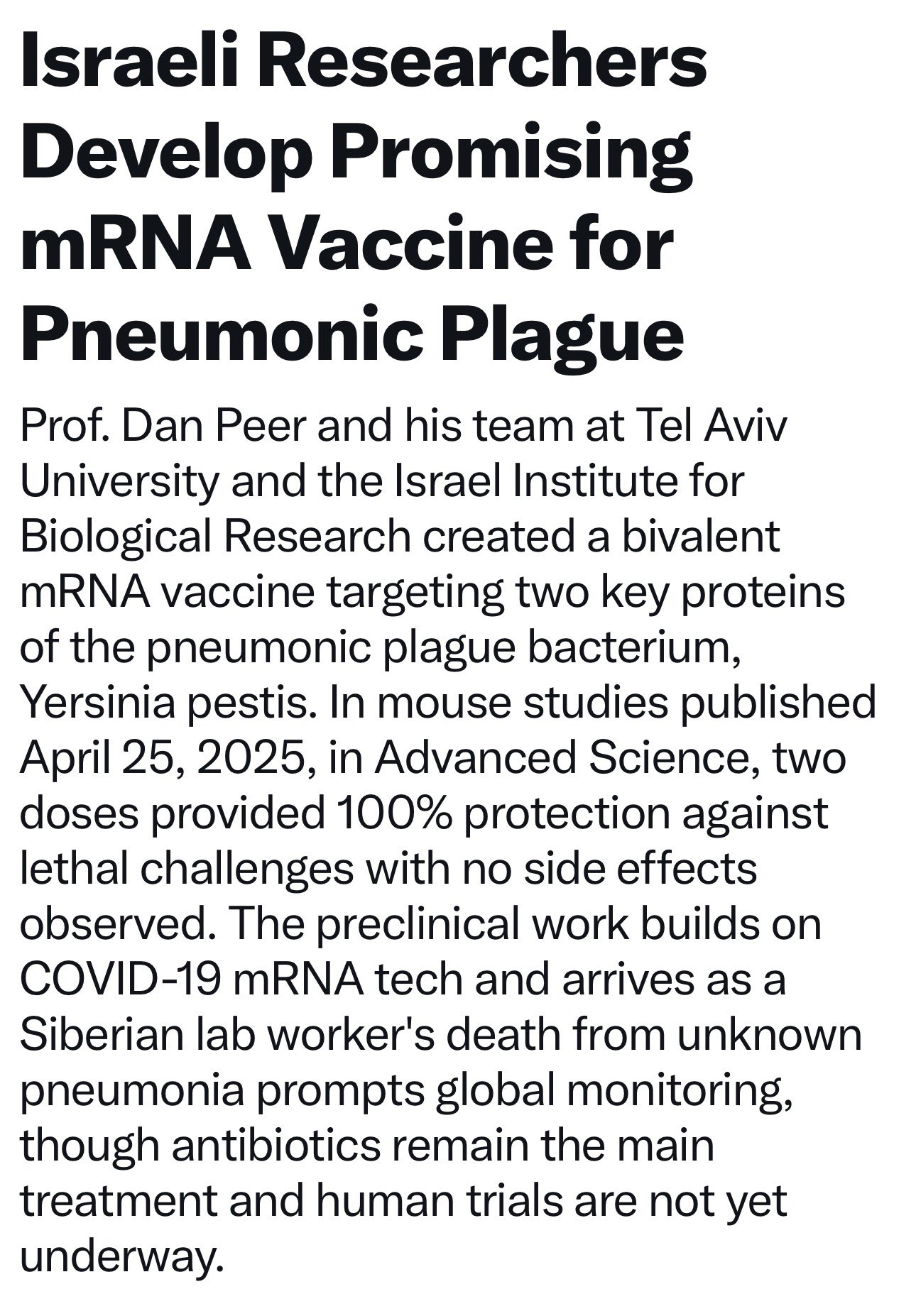
Israeli Scientists Develop First mRNA Vaccine Against Antibiotic-Resistant Yersinia pestis, the pathogen responsible for the pneumonic plague

In a global first, Israeli researchers have developed an mRNA bacterial vaccine that successfully combats an antibiotic-resistant bacterium—Yersinia pestis, the pathogen responsible for the pneumonic plague. The vaccine, tested on animal models, showed 100% effectiveness, preventing illness and death following exposure.

The research, led by Prof. Dan Peer at Tel Aviv University and Dr. Edo Kon from the Israel Institute for Biological Research, uses lipid nanoparticles to deliver bacterial protein-coding mRNA into cells. While mRNA vaccines have already proved effective against viruses like COVID-19, this marks the first time such a platform has worked against a bacterial infection—a more complex challenge.

Breakthrough in Science: How the Vaccine Works

Bacteria don’t rely on host-cell replication like viruses do, making vaccine development particularly difficult. The scientists addressed this by designing a bivalent mRNA bacterial vaccine that targets two separate bacterial proteins. Once injected, human cells produce these proteins, triggering a strong immune response. After two doses, the test animals showed complete protection from exposure to the lethal pathogen.

According to Prof. Peer, this innovation represents “a significant scientific achievement and proof of concept,” proving mRNA technology can be tailored for a wider range of pathogens. The researchers now plan to expand their work to other drug-resistant bacteria such as MRSA and tuberculosis.

The implications for global health are enormous. The World Health Organization has long warned that antibiotic resistance could become one of the leading causes of death worldwide by 2050. This development offers a game-changing tool for preemptive protection, especially in hospitals where bacterial infections are common.

mRNA’s Expanding Role: From Pandemic to Plague

The vaccine also made headlines in India, with The Times of India highlighting its success and potential applications. Notably, the pneumonic plague—transmitted through the air—is highly fatal and has long been a concern for bioterrorism and sudden outbreaks. Despite being historically infamous for the Black Death, plague cases still occur in parts of Africa and Asia. An mRNA bacterial vaccine that neutralizes it offers both medical and strategic value.

Experts believe this success confirms the versatility of mRNA technology, not just for viral pandemics, but also for emerging bacterial threats. The vaccine’s rapid development, strong immune response, and scalability could reshape how the world responds to infectious disease, especially in the face of rising antimicrobial resistance.

What’s Next?

  • Clinical Trials: Human testing is the logical next step, but regulatory pathways for mRNA-based bacterial vaccines are still evolving.

  • Logistics: Like COVID-19 vaccines, this candidate also depends on cold-chain storage, which remains a logistical challenge.

  • Global Impact: The technology could be adapted for rapid vaccine deployment during outbreaks or even used preventively in hospitals.

This pioneering mRNA bacterial vaccine marks a turning point in the global fight against antibiotic resistance. With full protection demonstrated in preclinical trials, it sets the stage for a future where bacterial pandemics might be prevented before they even begin. As research progresses, the hope is that mRNA will evolve from a pandemic response tool to a cornerstone of everyday medical defense.

Source: Israeli Scientists Pioneer First MRNA Bacterial Vaccine Against Superbugs | The Lifesciences Magazine

I am suspicous of any so called plague outbreak a day or 2 before the Israelis announce they have an mRNA vaccine for it....

1 Like

Is the 'Russian Plague' a DARPA Bioweapon? | Dr. David Martin

“Patient zero” is back. In this episode, I sit down with Dr. David Martin to examine the reported Russian laboratory death and the hidden paper trail he connects to biological-warfare research, patents, vaccines, and DARPA’s “Prophecy” program. We also explore his claim that global control is already here, and why defeating the system requires confronting the fear, shame, and programming it has planted within us. - Source: Man in America.