



How to Grow Microgreens: A Beginner’s 101 Guide
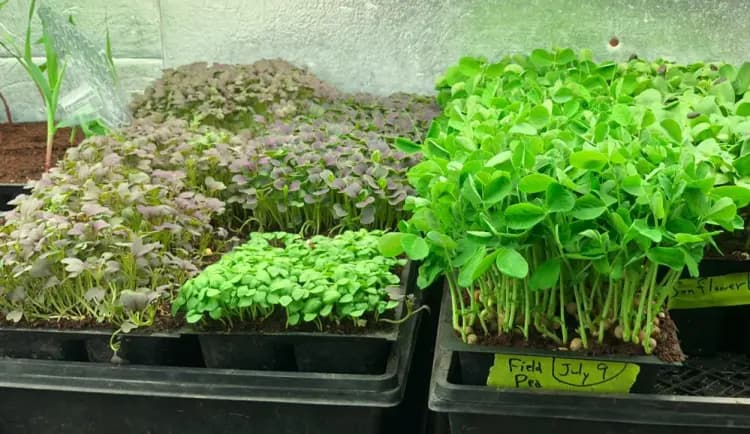
Not eating–or growing–microgreens yet? Then you’re missing out on a seriously easy way to increase your nutrient intake. Researchers from the U.S. Department of Agriculture and the University of Maryland found that leaves from microgreens had more nutrients than the mature leaves of the same plants, and often have intense flavor too. Better yet? You can grow your own microgreens. Let’s take a look at what they are and how you can introduce them to your own garden…and diet.
What are microgreens?


Victory gardens, also called war gardens or food gardens for defense, were vegetable, fruit, and herb gardens planted at private residences and public parks in the United States, United Kingdom, Canada, Australia and Germany during World War I and World War II.
In Britain, "digging for victory" used much land such as waste ground, railway edges, ornamental gardens and lawns, while sports fields and golf courses were requisitioned for farming or vegetable growing. Sometimes a sports field was left as it was but used for sheep-grazing instead of being mown.
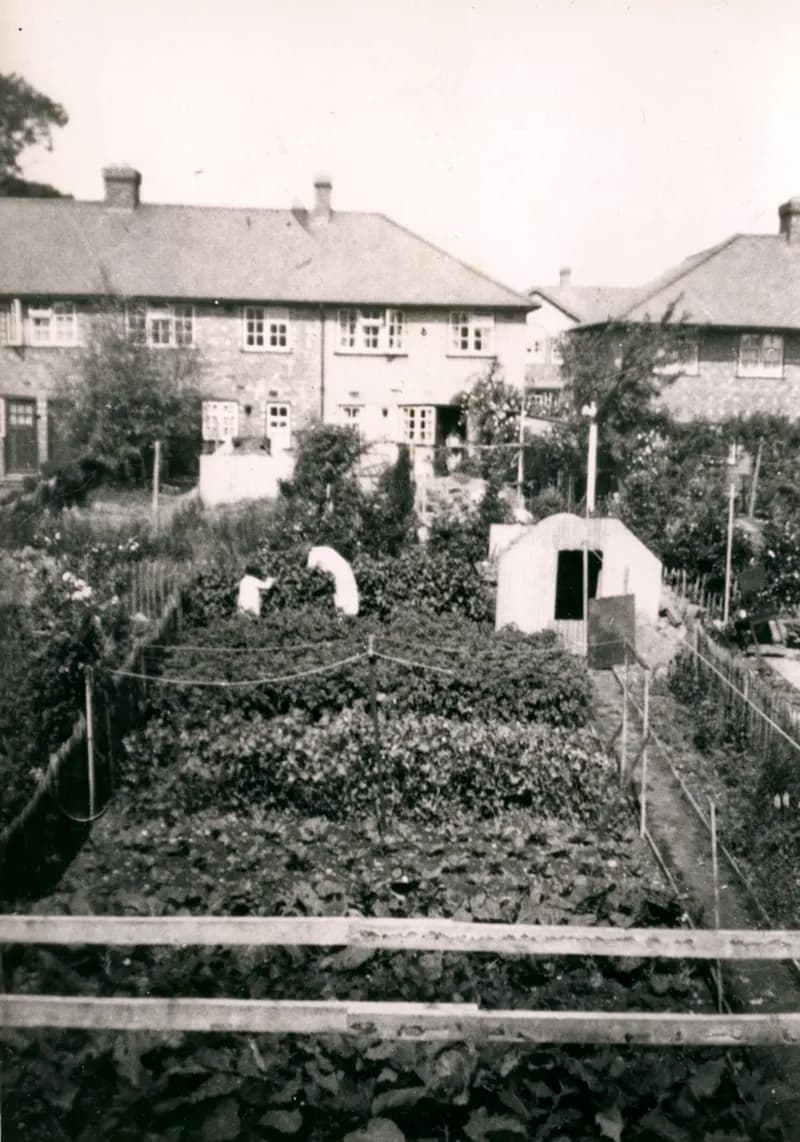
In the UK, they call backyards "gardens".
Is it coming around again?
I also warned years ago that Gibraltarians need to grow food in every square inch of garden and piece of soil, including in window-boxes, because every morsel of food is currently IMPORTED, and thus leaves Gibraltarians extremely vulnerable to starvation, like the Palestinians. - https://gibraltar-messenger.net/letters/preparing-for-war/


The Forgotten Amish Pest-Control System That Turns Your Garden Into A Fortress
Wednesday, May 20, 2026 9:09
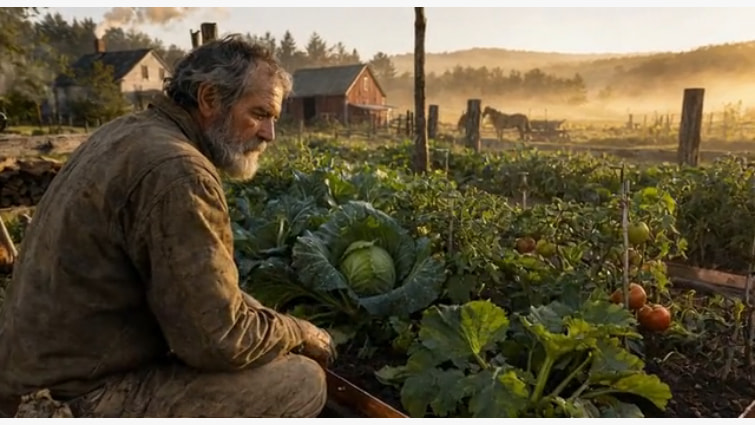
Two Cheap Metals The Pesticide Companies Hope You Never Rediscover
You’re standing in your garden at sunrise, coffee steaming in the cool morning air, boots wet with dew. Everything looks peaceful for about ten seconds.
Then you see the damage.
Fresh holes chewed through your cabbage leaves. Aphids packed thick along your tomato stems like squatters who moved in overnight. Squash bugs crawling across your zucchini plants with the confidence of thieves who know nobody’s stopping them.
And suddenly that peaceful little homestead feeling turns into frustration.
You sprayed already. Maybe twice. Maybe three times. Yet somehow the bugs keep coming back stronger, hungrier, and meaner every week.
Now here’s the question most people never ask:
What if the answer isn’t another spray bottle at all?
What if two cheap metals sitting on a hardware-store shelf could stop most crawling and chewing pests without constant spraying, endless reapplication, or dumping mystery chemicals all over the food you’re trying to feed your family?
That sounds like folklore until you see it with your own eyes.
And out in Amish country, many families have quietly been using variations of this approach for generations.
The Potato Patch That Didn’t Make Sense
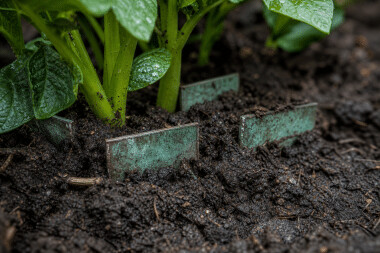
Nineteen years. Same copper strips. Same ground. Zero beetles. That’s not luck — that’s a system that gets stronger every season.
The first time I saw it, it honestly bothered me a little.
Because it shouldn’t have worked that well.
Some Amish folks around these parts can walk you through their garden on a humid summer morning. If you’ve ever grown potatoes, you already know about potato beetles. Those striped little devils can strip healthy plants down to skeletons almost overnight.
It’s true. Amish gardens often looked untouched.
No ragged leaves. No beetles chewing away. No wilted stems.
Just thick, dark-green plants standing strong in neat rows like they belonged in an old seed catalog illustration.
And the strangest part?
They aren’t spraying anything.
No backpack sprayer. No organic concentrate. No chemical fog drifting across the rows at sunrise.
Instead, they’ll show you narrow copper strips pushed into the soil around the beds. Most will be only a couple of inches wide, buried shallow with just the top edge exposed above the dirt.
That’s it.
Simple. Quiet. Cheap.
According to research referenced through Cornell University’s IPM program, copper reacts with slug slime and creates a disruptive effect that many soft-bodied pests avoid crossing. Similar barrier concepts have shown strong effectiveness in reducing slug movement in protected areas.
But standing there beside those potatoes, it didn’t feel like science at first.
It felt like somebody had remembered an old trick the modern world forgot.
The Garden Fence You Can’t See
Most folks think pest control means killing bugs.
That’s the whole modern gardening mindset.
Spray harder. Spray stronger. Spray more often.
But old homesteaders often looked at gardens differently. Instead of launching chemical warfare every week, they focused on making the garden itself harder to invade.
Copper acts almost like an invisible fence.
Many crawling pests simply refuse to cross it when it’s installed correctly in moist soil. Slugs, cutworms, earwigs, and even ants often avoid copper boundaries altogether.
And that matters more than people realize.
Because ants don’t just wander through gardens. They actually protect aphids like tiny livestock farmers. They move them, defend them, and help infest entire plants. Break the ants’ movement patterns, and aphid populations often collapse soon afterward.
Listen, modern gardening is usually reactive. The old homestead mindset was preventative.
One waits for invasion.
The other builds defenses before the attack starts.
Then Comes the Second Metal
Now here’s where things get even stranger.
Copper was only half the system.
The Amish families using these methods often paired copper with zinc — usually in the form of galvanized nails driven into stakes, trellises, or garden posts.
The old German-speaking farmers had a name for the effect: Spannungsfeld — roughly translated as a “tension field.”
Sounds mysterious. Maybe even a little odd.
But the basic idea is surprisingly simple.
When copper and zinc exist together in moist soil, they create a weak electrical interaction. The soil itself becomes part of the circuit.
In other words, your garden starts behaving almost like a tiny low-voltage battery.
Research published through the Spanish Journal of Agricultural Research examined how electrical barriers dramatically reduced slug crossings under certain conditions. The principle isn’t magic. It’s conductivity, moisture, and biological sensitivity working together.
The Amish farmers didn’t need laboratory explanations to trust it.
They simply watched it work.
Generation after generation.
Why This Knowledge Quietly Disappeared
Now here’s the part that raises eyebrows.
According to old agricultural reports referenced in Pennsylvania archives, county agents once documented farms using copper-and-zinc systems with surprisingly low pest damage. Yet by the middle of the twentieth century, those techniques had largely vanished from mainstream gardening education.
Why?
Because agriculture changed.
After World War II, chemical pesticides exploded onto the market. DDT arrived. Organophosphates followed. University extension programs shifted heavily toward commercial chemical solutions because that’s where research money and industrial momentum were flowing.
And slowly, older low-cost methods faded from public discussion.
Not outlawed.
Not officially disproven.
Just… forgotten.
Meanwhile, plain farming communities kept quietly doing what had always worked for them.
That’s one advantage of cultural memory. Traditions survive when families pass them hand to hand instead of depending entirely on modern trends.
The Metals Don’t Just Repel Pests — They Feed the Plants
This is the part modern gardeners miss completely.
Copper and zinc aren’t only barriers.
They’re also micronutrients.
Copper plays a role in photosynthesis and lignin production. Lignin helps strengthen plant cell walls, making leaves and stems tougher and less attractive to chewing insects.
Zinc helps regulate enzyme activity and supports healthy root development.
And according to research published in Environmental Science & Technology, plants actively absorb ionic forms of copper and zinc from soil solutions during the growing season.
We’re not talking about dumping toxic amounts into the ground.
We’re talking trace mineral activity.
Tiny amounts.
But sometimes tiny things matter most.
Healthy plants behave differently than weak plants. They produce different compounds. Different scents. Different chemical signals.
Bugs know the difference.
That’s why pests almost always swarm the weakest tomato plant first.
Nature targets weakness.
Strong plants are harder targets.
And a 2023 study published in Nature Communications found that improved micronutrient availability can strengthen plant defense compounds tied to resilience and structural integrity.
In plain English?
Healthier plants naturally attract fewer attackers.
That’s old-fashioned homestead wisdom backed by newer science.
The “Heart of the Garden” Technique
Now here’s the strangest part of all.
Buried inside one Amish field report was a detail almost nobody talks about anymore.
At each corner of the garden plot, the farmer reportedly buried small clay pots flush with the soil surface. Inside each pot sat two things:
A copper penny and a galvanized nail.
Then he filled the pots with rainwater.
That was it.
The farmer supposedly called those corner pots “the heart of the garden.”
At first glance, it sounds almost superstitious.
Until you hear the explanation from agricultural chemists.
Rainwater is slightly acidic. Over time, tiny trace ions from the copper and zinc slowly dissolve into the water and disperse outward through surrounding soil moisture.
According to research involving soil-solution movement and metal ion availability, micronutrients travel through moisture gradients and organic matter zones across root systems.
In theory, those corner pots create a broad micronutrient field throughout the bed.
Not enough to poison anything.
Just enough to strengthen the plants over time.
And honestly, that’s what makes this whole thing fascinating.
The old homesteaders often approached farming like ecosystem management instead of warfare.
Instead of asking, “How do we kill the bugs?”
They asked:
“How do we make the garden stronger?”
That’s a very different philosophy.
How to Set It Up This Weekend
The beauty of this system is how ridiculously simple it is.
No subscriptions.
No monthly spray schedule.
No complicated gadgets.
Just basic materials.
You can grab copper flashing from almost any hardware store. Cut it into strips and place them vertically around raised beds or vulnerable crops with a small portion exposed above the soil.
Then add galvanized nails to wooden stakes, cages, or trellis posts throughout the garden.
That alone creates the basic copper-zinc interaction many old growers relied on.
If you want to try the corner-pot approach, bury four small terracotta pots at the corners of your main bed. Drop in a pre-1982 copper penny and a galvanized nail, then fill them with rainwater.
Cheap.
Simple.
Quiet.
The kind of solution old homesteaders loved because it kept working year after year without needing constant attention.
And honestly, that’s what makes this whole story hit so hard.
Modern gardening often feels exhausting. Every season brings a new product, a new infestation, a new expensive “solution.”
Meanwhile, old farming communities quietly kept using methods that cost less than a family dinner at a chain restaurant.
Maybe the Real Problem Was Never Your Garden
Here’s something worth thinking about at dinner tonight.
Maybe your garden struggles aren’t entirely your fault.
Maybe generations of gardeners slowly lost practical knowledge that once made growing food simpler, cheaper, and more resilient.
Because once agriculture became industrialized, every problem suddenly came with a product attached to it.
Spray for this.
Treat that.
Buy another bottle.
Then buy another one next month because the bugs adapted.
Meanwhile, old-school growers focused on soil, plant strength, mineral balance, and natural barriers that lasted for years instead of days.
That mindset feels almost rebellious now.
But maybe it’s just older. Simpler. Wiser.
And maybe that’s why so many homesteaders are circling back toward forgotten methods instead of chasing every shiny new gardening trend rolling off the assembly line.
Because deep down, most folks don’t really want a chemically dependent garden.
They want healthy soil.
Strong plants.
Clean food.
And the quiet satisfaction of walking through rows at sunrise without seeing their harvest getting eaten alive.
Sometimes the old ways survived for a reason.
And sometimes the cheapest solutions are the ones powerful enough to get forgotten on purpose.

Gardening sounds like Guard Eden.
Genesis 3:24 So He drove out the man; and He placed at the East of the garden of Eden, Cherubims, and a flaming sword which turned every way, to keep The Way of the tree of Life. King of kings' Bible - Genesis