Continuing the discussion from YOUR FOOD --- WHAT’S IN IT?:
Google NotebookML: Dysbiosis Explained and Cured by David Shapiro. (login to Google account needed to access this)
This notebook (the link above) on Google NotebookML is a comprehensive, AI-powered research compendium focused on human gut ecology, specifically the mechanisms of dysbiosis and protocols for recovery.
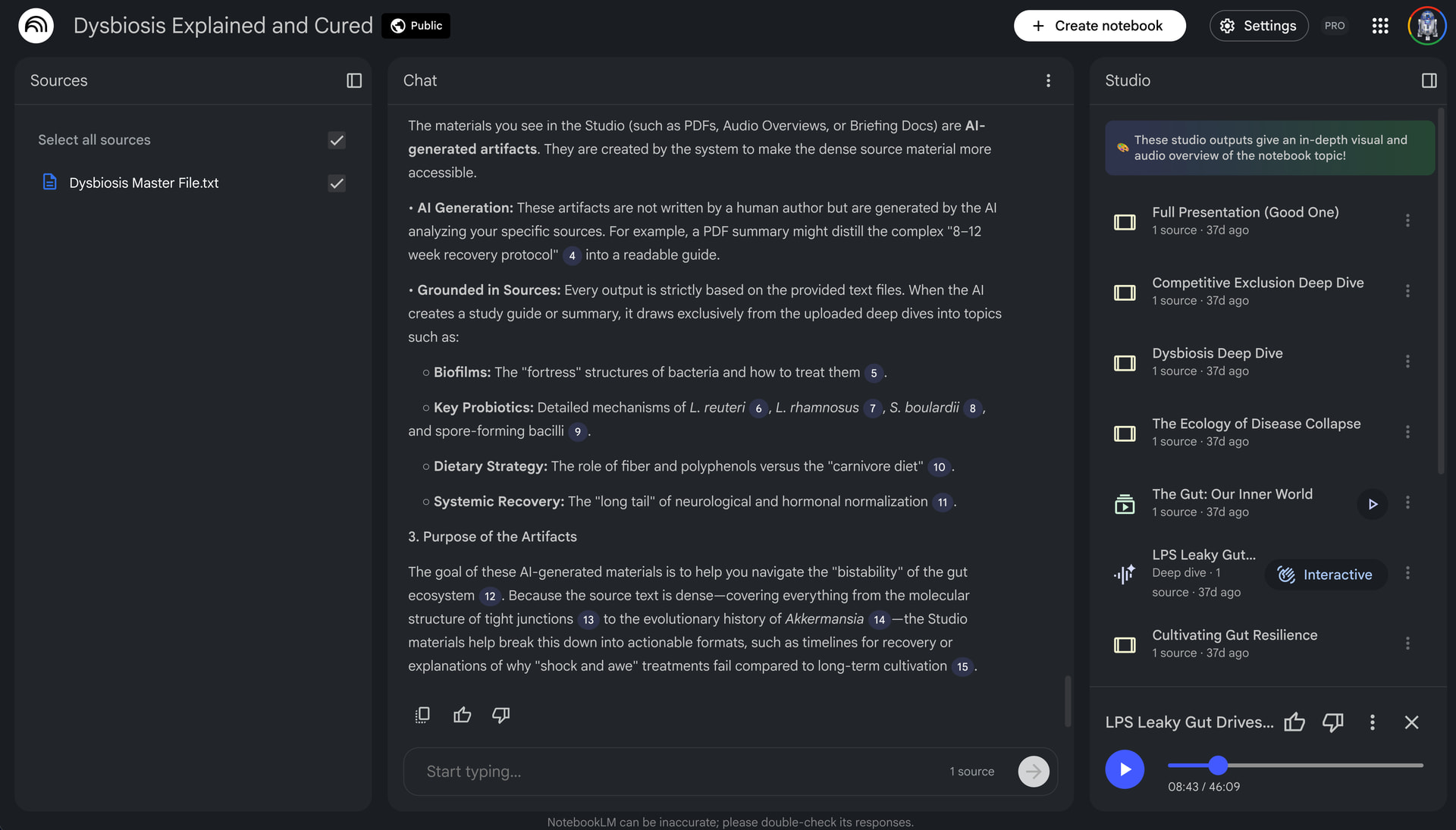
Screenshot:-
Good overview PDF:-
Click here for 46 minute Audio Deep dive
Here is an overview of this NotebookML system and the materials found in the Studio:
- What This Notebook Is
This notebook is an AI system designed to synthesize, organize, and retrieve complex information from the specific documents a user have uploaded. In this case, the notebook functions as a "Dysbiosis Master File," compiled by David Shapiro who meticulously studied and cured his Dysbiosis, containing a deep historical and biological analysis of gut health. It does not merely store text; it understands the semantic connections between topics—linking the history of "autointoxication theory" to modern concepts like "metabolic endotoxemia".
- Materials Made in the Studio
The materials you see in the Studio (the right most panel when accessing this site on a computer) (such as PDFs, Audio Overviews, or Briefing Docs) are AI-generated artifacts . They are created by the system to make the dense source material more accessible.
• AI Generation: These artifacts are not written by a human author but are generated by the AI analyzing the users specific sources. For example, a PDF summary might distill the complex "8–12 week recovery protocol" into a readable guide.
• Grounded in Sources: Every output is strictly based on the provided text files. When the AI creates a study guide or summary, it draws exclusively from the uploaded deep dives into topics such as:
◦ Biofilms: The "fortress" structures of bacteria and how to treat them.
◦ Key Probiotics: Detailed mechanisms of L. reuteri , L. rhamnosus , S. boulardii , and spore-forming bacilli.
◦ Dietary Strategy: The role of fiber and polyphenols versus the "carnivore diet".
◦ Systemic Recovery: The "long tail" of neurological and hormonal normalization.
- Purpose of the Artifacts
The goal of these AI-generated materials is to help you navigate the "bistability" of the gut ecosystem. Because the source text is dense—covering everything from the molecular structure of tight junctions to the evolutionary history of Akkermansia —the Studio materials help break this down into actionable formats, such as timelines for recovery or explanations of why "shock and awe" treatments fail compared to long-term cultivation.
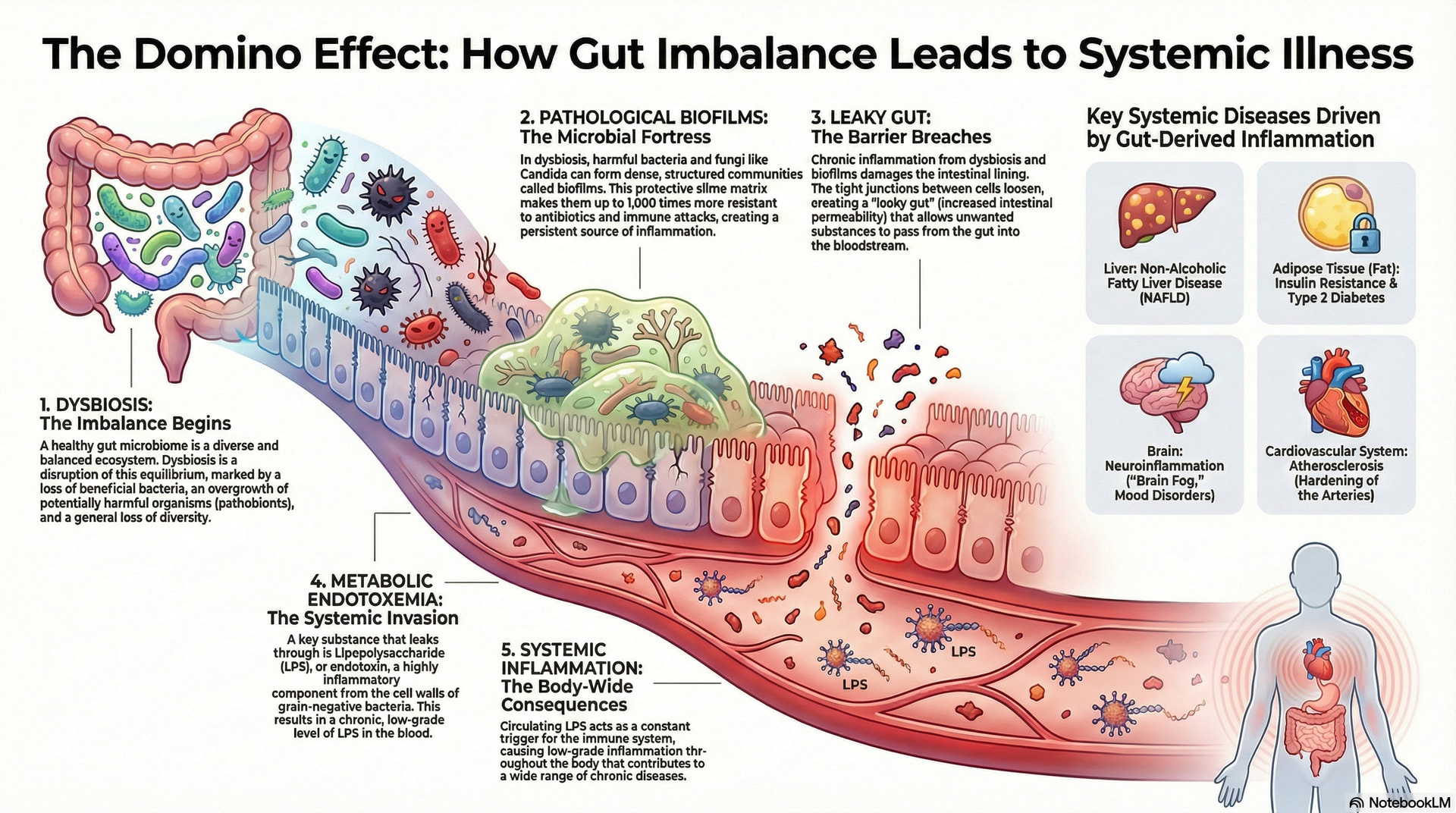
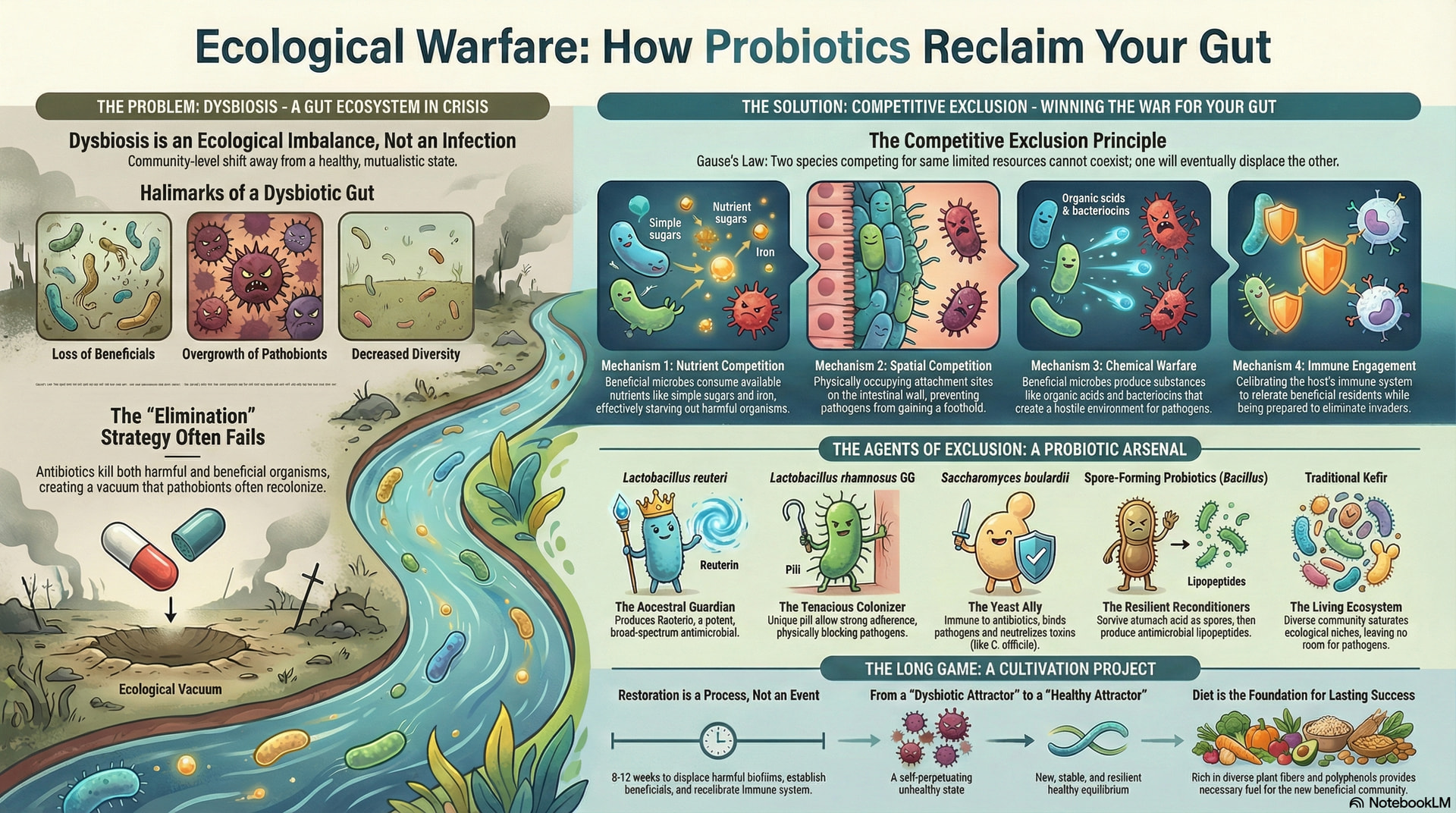
These documents offer a detailed analysis of human dysbiosis , defining it as an ecological imbalance of the microbiome rather than a simple infection. The text traces the concept from historical intuitions and the work of Elie Metchnikoff to modern medical models involving biofilms , leaky gut , and metabolic endotoxemia . It contrasts the clinical traditions of nations like Germany and Russia with the Western medical approach , while exploring how chronic microbial disruption may have affected figures like Charles Darwin . Practical guidance is provided on restorative protocols , highlighting the roles of specific probiotics , traditional kefir , and high-fiber diets in rebuilding a stable ecosystem. Ultimately, the sources advocate for a long-term cultivation strategy over several months to successfully transition the body from a pathological state to a healthy, self-sustaining equilibrium .

alternatively we can read the raw material that this is based on:-
dysbiosis master file by david shapiro.pdf (556.7 KB)
which starts like this:-
Tell me everything you can about dysbiosis in humans. History, theories, medical models, how different medical establishments look at it (US, Germany, Japan, Russia). And some suspected/possible cases from history (Alfred the Great, Charles Darwin).
4:17 AM
Synthesized dysbiosis history, mechanisms, and cultural medical perspectives comprehensively.
46s
Dysbiosis: A Comprehensive Examination
Conceptual Foundation
Dysbiosis—from Greek dys (bad, difficult) and symbiosis (living together)—denotes a disruption in the equilibrium of microbial communities inhabiting a host organism. While the term applies to any body site harboring a microbiome (skin, oral cavity, vagina, respiratory tract), it most commonly references the gastrointestinal tract, whose microbial inhabitants outnumber host cells and encode vastly more genetic information than the human genome itself.
The concept rests on recognizing that the relationship between humans and their microbiota is not merely commensal but fundamentally mutualistic—bacteria perform metabolic functions the host cannot, synthesize essential vitamins, educate the immune system, maintain epithelial barrier integrity, and produce neuroactive compounds that influence brain function. Dysbiosis represents a departure from this functional equilibrium toward a state characterized by: loss of beneficial organisms, expansion of pathobionts (organisms normally present but potentially harmful when ecological constraints are removed), diminished overall diversity, and altered metabolic outputs that affect host physiology systemically.
What makes dysbiosis conceptually distinct from simple infection is its ecological rather than singular-pathogen character. One does not "catch" dysbiosis from a single organism; rather, it represents a community-level shift with emergent consequences
.............................................................continued...
and is very long.... (587kb raw text)