https://www.thetruthseeker.co.uk/?p=317684
Russia completes successful test launch of long-anticipated nuclear-powered underwater Poseidon torpedo drone

TED POSTOL: Burevestnk Missile & Poseidon Torpedo, What We Know
In late October, President Vladimir Putin showcased two nuclear-powered, nuclear-armed systems: Poseidon: a long-range, nuclear-powered underwater drone. Burevestnik: a nuclear-powered cruise missile with “unlimited range.” General Gerasimov stated that on October 21, Burevestnik flew for many hours, covering 14,000 km, and demonstrated the ability to hit any target at any distance while bypassing air/missile defenses. Many Western observers doubted the missile’s existence or functionality; some claimed the recent test wasn’t nuclear-powered because no radiation was detected. MIT Professor Ted Postol is brought in to analyze what is real and what is exaggerated.
His conclusions:
- The missile is practically unlimited in range.
- Postol says the missile could loiter above the U.S. and then dive to strike from any direction with little warning.
- Historical Background: The Tech Isn’t New. Both the U.S. and USSR tried nuclear-powered aircraft and missiles in the 1950s–60s. Examples included reactor-powered ramjets with outputs of 400–500 megawatts. The programs were abandoned because: Early ICBMs became reliable, heavy-lift vehicles capable of accurate global nuclear delivery. Old nuclear engines produced: dangerous radiation plumes, massive environmental contamination, electronics failures due to high radiation. Reactors were so large that shielding was impossible. However, Russia appears to have solved these issues by developing a far smaller reactor—hundreds of times less powerful—sufficient for subsonic cruise speeds.
- Lack of radiation detection does not indicate a non-nuclear engine.
- The Burevestnik is technologically feasible and consistent with what is known.
- Detection is extremely difficult, especially from head-on angles.
- Tracking nearly impossible.
- The missile can circle or hover over oceans or remote regions for hours, days, or longer before receiving a command to strike.
1 Like
1 Like

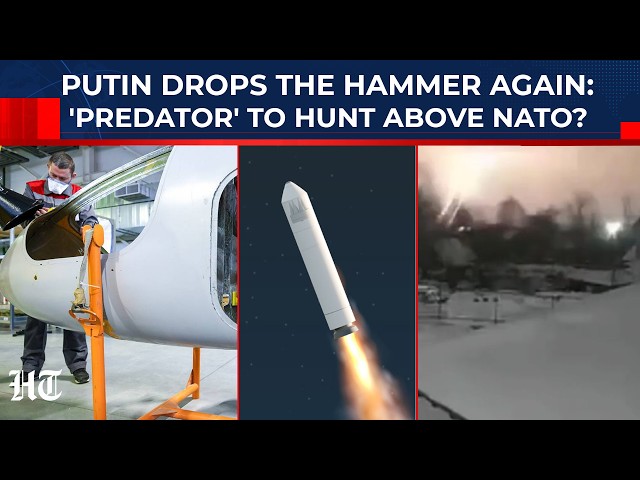
From Oreshnik To Stratosphere: Russia’s Weapon Stuns NATO, 'Predator' To Fly Beyond Arrow & Patriot?

Russia Activates S-500, Ultimate Defence Against Oreshnik; Trump 'SHOCKED' At Putin's New Red Line

1 Like

The Launch of IRBM 'ORESHNIK-2' by Russia triggered a MASS Evacuation of Western Diplomats from KIEV

This second one is AI generated:-
The US Just Used a CLASSIFIED Weapon in Iran

On March 3, 2026, the world watched as the U.S. military executed Operation Epic Fury. But while the B-2s and F-22s grabbed the headlines, it was a single, classified line in a CENTCOM fact sheet that sent shockwaves through the defense community: “...and special capabilities we can’t list here.” What happens when a nation’s entire integrated air defense system, built over decades with Russian and Chinese hardware, simply stops working? In the opening minutes of the strike, Iranian S-300 batteries stayed silent, radio networks vanished, and command centers lost all contact. No missiles were launched. No pilots scrambled. In this video, we dive deep into the mystery of the "First Movers." We analyze the official reports from U.S. Cyber Command and Space Command to uncover how the U.S. achieved total system nullification without a single kinetic impact. What We Cover: The "Special Capabilities" Mystery: Why the Pentagon is open about B-2s and Stealth Drones but silent on this new tech. The CHAMP Factor: Could high-power microwaves be the reason Iranian electronics fried instantly? Space-Based Warfare: How the "Meadowlands" upgrade and the 16th Electromagnetic Warfare Squadron blinded Iran’s satellite links. The Stealth Legacy: Comparing this secret deployment to the F-117 in Panama and the Stealth Black Hawks in Abbottabad. Non-Kinetic Dominance: How "Task Force Scorpion Strike" and the new LUCAS drones are changing the cost-of-war equation. The era of traditional dogfights is over. We are witnessing the dawn of the "Invisible Strike."
For 70 Years Nobody Knew This U.S. Weapon Existed. Then Researchers Opened The Vault

For 70 years, the U.S. military kept one of its most terrifying weapons buried under layers of classification so deep that even mentioning its name could end a career. No photos. No blueprints. No public record. When researchers finally accessed the declassified files in 2018, what they uncovered changed everything we thought we knew about America's secret military history. In this video, we dive into the most classified and shocking weapons the United States ever built — weapons so powerful and so dangerous that the government chose to erase them from history rather than let the world know they existed.
Russia did the IMPOSSIBLE: Meet the Newest Complex 'CRONA' that made Drone Strikes on MOSCOW useless
China’s J-36 owns the skies while America’s F-47 remains PowerPoint presentation
While the US sixth-generation fighter jet F-47 is still stuck on the drawing board with a planned 2028 maiden flight date, its Chinese rival, the J-36, just keeps flying.
A fresh video of the J-36 prototype conducting a test flight emerged as the US Air Force requested a whopping $5.03 billion for Fiscal Year 2027 to try to complete the highly classified F-47 project.
Even if the F-47 makes a maiden flight in 2028, some projections push the plane’s operational service to the mid-2030s or even 2040s.
In contrast, the J-36 program has been flight-testing since December 2024 and late last month, China's People's Liberation Army released the first official footage of its sixth-generation plane.
*
Characteristics matter:*
 The J-36 features a tailless, diamond-shaped double-delta wing and a unique three-engine layout, features unrivalled for a tactical jet
The F-47 is designed as a pure air superiority fighter, whereas the J-36 is a hybrid fighter-bomber known for its massive range, payload, and versatility
The J-36's combat radius (~3,000 km) dwarfs the F-47's (~1,850 km) — a critical advantage for operations across the vast Indo-Pacific theater
Unlike the F-47, the J-36 emphasizes full-aspect stealth level (all-direction) rather than just frontal one
Specifications aside, the F-47 program could finally collapse due to the aircraft's soaring costs.
 The F-47’s price tag is projected to come to roughly $300 million per aircraft — roughly three times the price of an F-35. Even with a possible $1.5 trillion defense budget, $300 million per unit is considered unsustainable
Meanwhile, the J-36 is already flying, while the F-47 has yet to even take off. Guess which one will dominate the skies.
Source @Geopolitics Prime | Iran & Ukraine News Updates