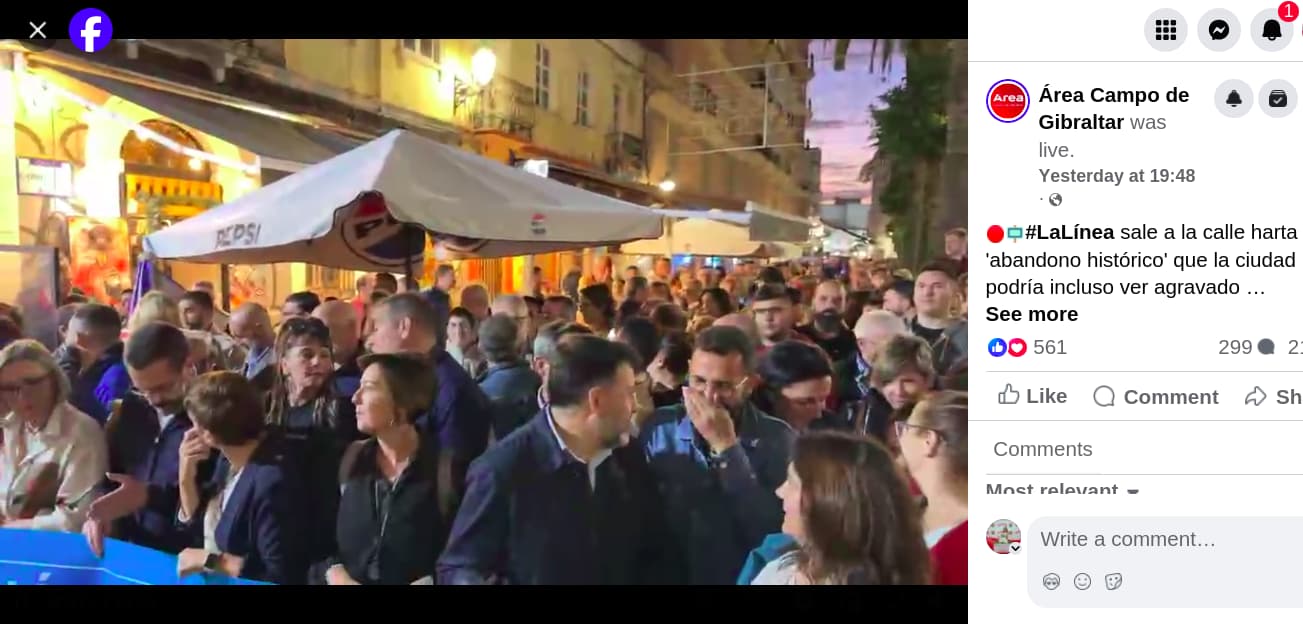
Spain panic as Madrid reveals fears for Gibraltar deal over Trump return
-MSN
Donald Trump's return to the White House could spell disaster for the already fragile agreement between the UK and Spain on Gibraltar more.
And this is the person in negotiations about the Gibraltar-Spain Border.
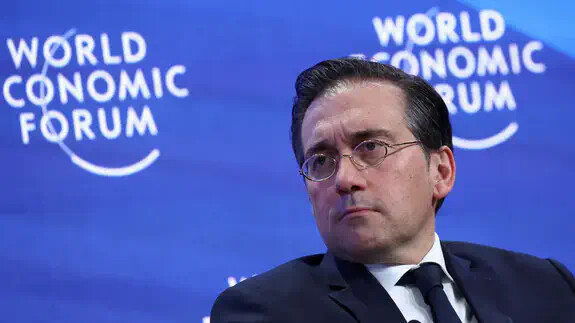
Jose Manuel Albarez, the Foreign Minister of Spain, decided to dismiss the Spanish ambassador to Belgium, Alberto Anton, after he was caught napping during the annual conference held in Madrid.
The Foreign Minister spoke for about an hour, during which the ambassador reportedly fell asleep.
The event occurred last month and was captured by press photographers who published the images on social media, showing the ambassador yawning and asleep.
In Spain, it was previously reported that the Foreign Minister creates a terrified atmosphere in his Ministry. It was also reported that recently the Spanish Foreign Minister fired seven diplomats who insulted him.
A Spanish diplomat told media in the country that the Foreign Minister "recalls events that happened 15 or 20 years ago - if someone didn’t greet him when he entered the office or said an inappropriate sentence - Jose remembers everything and eventually punishes those responsible."
Albarez is considered a socialist who opposes the monarchy, and for this reason, he banned mourning messages regarding the death of Britain's Elizabeth II.
It was also reported that the Spanish Ambassador to Croatia had to "face the wrath of the minister after publishing an article defending the King of Spain."
FEB 5 Marks Anniversary of Gib-La Linea Border Opening
The Gibraltar Border awaiting an agreement 40 years after its definitive opening.
On February 5, 1985, the opening was completed with the permit for the transit of vehicles and goods.
This historic moment made life easier for citizens on both sides of the border.
The Gibraltar Border commemorates this Wednesday 40 years of its total opening, when, in addition to people, motor vehicles were also able to circulate from one side of this small border crossing to the other. Then a 15-year blockade that "was a catastrophe" was ended, recalls Juan Carmona, mayor of La Línea de la Concepción until shortly before this event happened, in statements to RTVE.es.
It was on February 5, 1985. At midnight, crowds of neighbors crowded to witness the scene. With applause and cheers they celebrated the passage of the first vehicles that crossed the brand. Only two years earlier, pedestrian circulation had resumed and, therefore, people crossed the border on foot after thirteen years under the closure that separated families, friends and neighbors.
On 8 June 1969, the dictator Francisco Franco ordered the permanent closure of the border and the cutting off of communications, in response to the referendum by which the population of Gibraltar had unanimously shown their desire to belong to the British crown and to the entry into force of the Constitution that embodied it. Carmona points out that they thought that "Gibraltar would fall like a ripe fruit with isolation measures".
Juan Carmona, who in those years was involved in the process to request special authorization, experienced the negotiations first-hand. "Felipe González (with the first socialist government) and his Minister of Foreign Affairs, Fernando Morán, were absolutely determined, not only because of the historical mistake that Franco had committed, but also because of national interests," he points out. To keep the border closed with Gibraltar was to close our possibility of entry into the European common market and NATO at that time.
"It was a step forward, since the isolation meant for the Campo de Gibraltar region, and especially for La Línea, the loss of thousands of jobs," says the former councillor of the Cádiz municipality.
The border crossing, in a legal limbo
The future of the border is uncertain, since after Brexit the negotiations between the United Kingdom and the European Union (EU) - since October 2021 - for the integration of the colony into the Schengen area remain stalled. As a British overseas territory, the Rock cannot be part of Schengen or manage its own accesses, which has made this aspect one of the most delicate points to unblock the negotiation.
The Minister of Foreign Affairs, European Union and Cooperation, José Manuel Albares, spoke on the matter on Tuesday in an interview on TVE's La hora de la 1 programme. "At the moment there is a specific aspect on the free movement of people and another on goods that are the last stumbling blocks," the minister acknowledged, while insisting that all the parties involved agree on the need to reach a definitive agreement for Gibraltar.
Gibraltar's Chief Minister, Fabian Picardo, explains to RTVE.es that "Gibraltar has presented solutions to all the last outstanding issues" to be resolved "in a manner acceptable to all parties". The Gibraltarian leader specifies that they work in "good faith and prudence" and assures that what they put on the table "would not violate the fundamental positions of any of the parties involved in the negotiation and that they would protect the security of the Schengen area and preserve the integrity of the EU's Single Market". "If those solutions were accepted this week, we could have a treaty tomorrow," he concludes.
For his part, the current mayor of La Línea, Juan Franco, is pessimistic about the possibility of reaching an agreement soon. "No exceptional measures have yet been taken for this part of the national territory by anyone," he says. "The problem is the control of passage by Spanish police and customs agents. The Government of Gibraltar understands that another formula can be sought, and the Government of Spain considers that, with the Schengen treaty, it is what it has to do," he said in statements to RTVE.es.
The result that the lack of an agreement would have for the border was staged on November 22, when the agents of the National Police stationed at the border checkpoint with Gibraltar began to require the passport of citizens who were preparing to enter Spain by surprise, which caused a collapse of the border crossing – thus breaking the unwritten agreement by which Spain allows the plains to enjoy of lax controls at the Border –.
In October, the opposite was true, Spanish workers who intended to enter the British colony suffered long queues and detentions early in the morning because the Gibraltar authorities asked for a passport, instead of an ID card, as usual. "The (Spanish) minister told us that, if the agreement goes ahead, Gibraltar would become part of the Schengen area and this would not happen," Franco adds. "The main affected are the Spanish workers who come to the Rock every day to work," stresses the mayor of La Linea. Specifically, around 15,000 Spanish cross-border workers pass through this point and an average of more than 235,000 vehicles circulate per month and about 8,000 per day.
The fears of an agreement that never arrives
For now, the changes have been minimal. "Since the United Kingdom approved the European exit, both countries are turning a blind eye to European regulations in terms of the passage of people, goods and services," says Carmona, who was the first mayor of La Línea and continues to be very aware of the challenges that the municipality now faces.
The current councillor, Juan Franco, confesses that the situation "can be even worse than the one experienced in '69" if the pact does not contemplate measures that protect the town and the rest of the region. "In the event that they are only looked at for international interests and La Línea is left aside, a cataclysm can be generated again," he says.
The absence of agreement is already hurting at different levels but, above all, economically. "We must avoid a bad agreement that damages our companies," Franco claims, while adding that a week ago he met with a company that had an attractive project and finally, as on other occasions, everything remains on paper because the pact is not concluded.
Neighbors await the effects of Brexit on tenterhooks
The nightmare they experienced in the 80s threatens the population of the area again, although a closure is no longer possible, but a consideration of a European border with a third country. The joint use of the airport and customs control have been the focus of talks between the negotiating teams for months due to the great complexity and reluctance of both parties. However, all parties have repeatedly expressed their goodwill and commitment to resolving the outstanding issues.
Minister Albares wanted to unravel the negotiation last year, with what were called high-level summits. The last meeting was held on 19 September, with his UK counterpart, David Lammy, the European Commission's Executive Vice-President, Maroš Šefčovič, and Gibraltar's Chief Minister, Fabián Picardo. Like previous ones, it ended with a public message that they had made "new progress".
Both the first mayor of that time in La Línea and the one now agree that the treaty "is practically closed". Franco wonders why if this is the case it is not completed once and for all, Carmona goes a step further and affirms that "they are finding the right moment to make it public".
Meanwhile, the more than 300,000 residents of Campo de Gibraltar, and the more than 30,000 of the colony, live with the uncertainty of knowing if their future lies because this fence disappears or, on the contrary, hardens. While waiting for clear rules of the game to be established, in terms of the regime of passage of people, vehicles and goods, everyone is confident of maintaining the intense relations that historically unite citizens on both sides of the Border, although today, five years after Brexit, everything is still up in the air.
Britons will have fingerprints taken at Gibraltar’s new border
Britons will have their fingerprints taken to enter Gibraltar as new post-Brexit border controls come into force.
The UK-EU agreement to create an open land border between Gibraltar and Spain has been signed in Brussels – and from Wednesday it will make Gibraltar effectively part of the bloc's passport-free Schengen Zone, with the removal of checkpoints and border fences.
But it introduces Spanish border controls at Gibraltar's airport, raising fears about sovereignty and concerns over queues caused by the EU's entry/exit system (EES).
To enter Gibraltar, air passengers must show their passports to Gibraltarian officials and then Spanish border guards, who have the final say on entry to Schengen.
They must also submit to the biometric checks in the new electronic system, which replaces "wet" passport stamps and has been blamed for long queues at the borders of EU countries.
The deal will ensure frictionless travel across a land border, which is traversed by some 15,000 people every day and where controls were still very much in place on Tuesday.
Juan Franco, the mayor of La Línea, the Spanish municipality that borders Gibraltar, described the agreement to remove the border crossing as "very good news", especially for thousands of cross-border workers, "who now have the security of knowing they will keep their jobs".
He said: "The alternative would have been a disaster. Crossing the border is vital. Keep in mind that 11,000 people live in our city and work in Gibraltar, plus another 5,000 who live in the surrounding towns and cities. In other words, if we had encountered a barrier there, it would have been a complete economic and social disaster for the city."
He will meet Fabian Picardo, the chief minister of Gibraltar, at midnight local time at the border fence to mark the solution to the problems caused by Brexit and the end of the uncertain negotiations that have lasted years.
Maros Sefcovic, the EU Brexit negotiator, hailed the deal as historic after a signing ceremony in Brussels with Stephen Doughty, a minister of state for Europe.
Daisy Montero, a 54-year-old from Colombia, who has been crossing the border into Gibraltar to work in a hotel café for the past 20 years, said it would protect citizens from Spanish border guards' abuse of power. "I am so happy to be part of this history. It was completely unexpected," she added.
"When we have had crises here at the border because of Spain, we have had to wait for two or three hours to cross. The Spanish police are not kind, and they don't care if you're standing here in the sun with a baby in your arms. The Gibraltar police are much more organised and empathetic."
The Colombian, who has also worked in the care sector in Gibraltar, added that residents of the Rock she knew were worried about security in future.
"I walk home at 11pm through the border area and I have no fears, but now Gibraltarians are wondering who is going to be able to enter without any controls."
Andrés Jiménez, a maintenance worker who calculates he could save an hour or two a day that would have been spent in queues, said: "I hope it's good for all of us. I drive across three or four times a day as I take my wife to work at a different time."
Brexit posed serious challenges to Gibraltarians, who, in separate referendums, have voted overwhelmingly to stay British and, in 2016, backed remaining in the EU.
The Spanish workers and Gibraltarians who cross the border every day faced post-Brexit limits to visa-free travel of 90 days every 180 days. Spanish workers are vital to Gibraltar's economy, and the Rock is a crucial source of employment for La Línea, in one of Spain's poorest regions.
Many on the strategically important territory on the Mediterranean also have family or second homes on the Spanish side of the frontier.
There were also fears about food supplies to the Rock. To guard against a no-deal Brexit, Gibraltar stored supplies of drugs and other goods in the tunnels under its monkey-inhabited Rock.
Gibraltar was left out of the UK-EU trade deal that came into force at the end of 2020, when Brexit took practical effect.
Talks between the UK and Gibraltar, Spain and the EU lasted for three and a half years before a deal was done last June. Before then, Spain and Gibraltar both turned a blind eye to post-Brexit rules that required passport-stamping on the land border to mark the use of visa-free travel days.
Spaniards and Gibraltarians, as well as those with residency cards, were allowed to cross the border without having their passports stamped.
The treaty was agreed after warnings that the fudge could not survive the introduction of the EES. The electronic system requires fingerprints and face scans, and replaces "wet" passport checks.
Spain has said it is ready to implement the new system at Gibraltar's airport "immediately", raising fears about queues at the new border. The presence of Spanish border guards, the requirement for Britons to show their passports to them and their veto on entry, is controversial and was criticised by Brexiteers.
Mr Picardo insisted it was not a breach of his promise that there would be "no Spanish boots on the ground" as part of the deal. He said the guards would be in a "Schengen shack" – a joint facility half in Gibraltar and half in Spain.
There were also rows over other parts of the deal that the Conservatives and Reform UK criticised as a sacrifice of sovereignty, and likened to Sir Keir Starmer's surrender of the Chagos Islands.
Britain's military base on Gibraltar will be subject to EU inspections under the new Brexit border treaty. Spanish officers acting on behalf of the EU will be able to board British warships and inspect RAF aircraft under a "special procedure" designed to protect the single market.
Britain will also have to notify Spain of any movement of weapons to the strategically vital military base, which will be subject to strict monitoring rules, with arms stored in named secure storage facilities, which inspectors will be able to verify.
Spanish officers will be handed the power to carry out surveillance at the airport and port of the British Overseas Territory, as well as to stop unlawful crossings, arrest illegal migrants and deport them.
Gibraltar has aligned with some EU rules to remove the need for border infrastructure with Spain. Minimum EU excise rates will now apply on the Rock, which means cigarettes and alcohol will become more expensive.
Packaged food on shelves will have to be stamped "not for EU" and drugs "UK only" if they do not meet EU standards.
Spain still claims Rock as its own
Madrid continues to claim sovereignty over Gibraltar, which was ceded to the British crown in the Treaty of Utrecht in 1713.
Both London and Gibraltar hailed a "sovereignty clause" in the Brexit deal, which states that nothing signed "shall constitute the basis for any assertion or denial of sovereignty" over the Rock.
Madrid says the clause is proof that it has not given up its claim on the territory, which it views as a colony and does not recognise as British.
"This is the deal that guarantees that Gibraltar can stay British in the future. Brexit could have created huge economic dangers for Gibraltar that might have pulled it away from Britain, and this deal saves us from all of that," Mr Picardo told The Telegraph last week.
It's a new era for the Rock, where border controls with Spain have lasted 118 years. Francisco Franco closed the border, starting a non-military siege of the British Overseas Territory that lasted for more than 13 years from 1969 to 1982.
Periodically, Gibraltarians have accused Spain of using the frontier to exert political pressure by introducing stricter checks since then.
During the American Revolutionary War, a combined French and Spanish force unsuccessfully waged the Great Siege of Gibraltar, which lasted for three years, seven months and 12 days until Feb 7, 1783. It remains the longest siege ever endured by British forces. Sourcehttps://www.yahoo.com/news/politics/articles/britons-fingerprints-taken-gibraltar-border-131644000.html